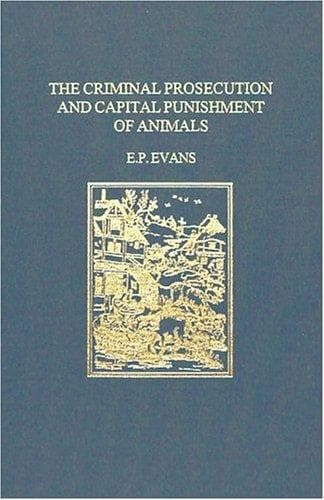
The Criminal Prosecution and Capital Punishment of AnimalsEvans, E. P. (Edward Payson)
History
The Criminal Prosecution and Capital Punishment of Animals
Evans, E. P. (Edward Payson)
Animals -- Law and legislation -- History; Animals, Prosecution and punishment of -- History; Trials -- Europe
The Koran holds every beast and fowl accountable for injuries done to
each other, but reserves their punishment for the life to come. Among the
Kukis, if a man falls from a tree and is killed, it is the sacred duty of
the next of kin to fell the tree, and cut it up and scatter the chips
abroad. The spirit of the tree was supposed to have caused the mishap, and
the blood of the slain was not thought to be thoroughly avenged until the
offending object had been effaced from the earth. A survival of this
notion was the custom of burning heretics and flinging their ashes to the
four winds or casting them upon rivers running into the sea. The laws of
Drakôn and Erechtheus required weapons and all other objects, by which a
person had lost his life, to be publicly condemned and thrown beyond the
Athenian boundaries. This sentence of banishment, then regarded as one of
the severest that could be inflicted, was pronounced upon a sword, which
had killed a priest, the wielder of the same being unknown; and also upon
a bust of the elegiac poet Theognis, which had fallen on a man and caused
his death. Even in cases which, one would think, might be regarded as
justifiable homicide in self-defence, no such ground of exculpation seems
to have been admitted. Thus the statue erected by the Athenians in honour
of the famous athlete, Nikôn of Thasos, was assailed by his envious foes
and pushed from its pedestal. In falling it crushed one of its assailants,
and was therefore brought before the proper tribunal and sentenced to be
cast into the sea. Judicial proceedings of this kind were called ἄψῦχων
δίκαι (prosecutions of lifeless things) and were conducted before the
Athenian law-court known as the Prytaneion; they are alluded to by
Æschines, Pausanias, Demosthenes, and other writers, and briefly described
in the _Onomasticon_ of Julius Pollux and the _Lexicon Decem Oratorum
Graecorum_ of Valerius Harpokration.
Public-domain text, read in full here on John Shaqi.
Reviews
Reviews
No reviews yet
Be the first to share your thoughts on this work.
Elsewhere in the archive
Join the Discussion
Join the discussion
Sign in to leave a comment or review.
Sign InorCreate an account