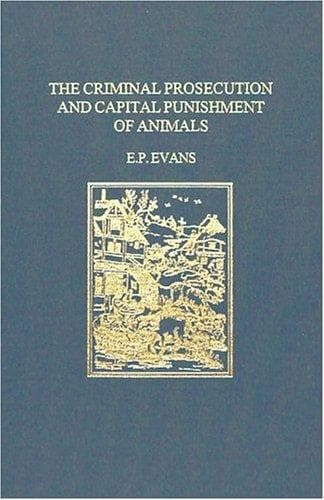
The Criminal Prosecution and Capital Punishment of AnimalsEvans, E. P. (Edward Payson)
History
The Criminal Prosecution and Capital Punishment of Animals
Evans, E. P. (Edward Payson)
Animals -- Law and legislation -- History; Animals, Prosecution and punishment of -- History; Trials -- Europe
The childish disposition to punish irrational creatures and inanimate
objects, which is common to the infancy of individuals and of races, has
left a distinct trace of itself in that peculiar institution of English
law known as deodand, and derived partly from Jewish and partly from old
German usages and traditions. “If a horse,” says Blackstone, “or any other
animal, of its own motion kill as well an infant as an adult, or if a cart
run over him, they shall in either case be forfeited as deodand.” If a
man, in driving a cart, tumble to the ground and lose his life by the
wheel passing over him, if a tree fall on a man and cause his death, or if
a horse kick his keeper and kill him, then the wheel, the tree and the
horse are deodands _pro rege_, and are to be sold for the benefit of the
poor.
_Omnia quae movent ad mortem sunt Deo danda_ is the principle laid down by
Bracton. If therefore a cart-wheel run over a man and kill him, not only
is the wheel, but also the whole cart to be declared deodand, because the
momentum of the cart in motion contributed to the man’s death; but if the
shaft fall upon a man and kill him, then only the shaft is deodand, since
the cart did not participate in the crime. It is also stated, curiously
enough, that if an infant fall from a cart not in motion and be killed,
neither the horse nor the cart shall be declared deodand; not so,
however, if an adult come to his death in this manner. The ground of this
distinction is not quite clear; although it may arise from the assumption
that the child had no business there, or that such an accident could not
have happened to an adult, unless there was something irregular and
perverse in the conduct of the animal or the vehicle. In the archives of
Maryland, edited by Dr. William Hand Browne and Miss Harrison in 1887,
mention is made of an inquest held January 31, 1637, on the body of a
planter, who “by the fall of a tree had his bloud bulke broken.” “And
furthermore the Jurors aforesaid upon their oath aforesaid say that the
said tree moved to the death of the said John Bryant; and therefore find
the said tree forfeited to the Lord Proprietor.”
Public-domain text, read in full here on John Shaqi.
Reviews
Reviews
No reviews yet
Be the first to share your thoughts on this work.
Elsewhere in the archive
Join the Discussion
Join the discussion
Sign in to leave a comment or review.
Sign InorCreate an account