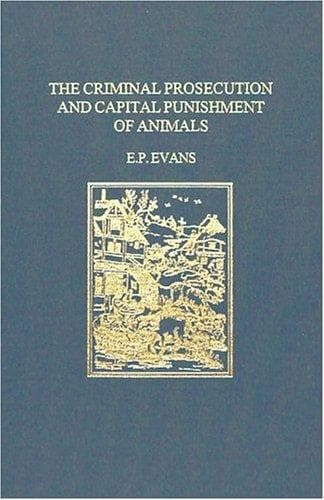
The Criminal Prosecution and Capital Punishment of AnimalsEvans, E. P. (Edward Payson)
History
The Criminal Prosecution and Capital Punishment of Animals
Evans, E. P. (Edward Payson)
Animals -- Law and legislation -- History; Animals, Prosecution and punishment of -- History; Trials -- Europe
According to an old Anglo-Saxon law a sword or other object by which a man
had been slain, was not regarded as pure (_gesund_) until the crime had
been expiated, and therefore could not be used, but must be set apart as a
sacrifice. A sword-cutler would not take such a weapon to polish or repair
without a certificate that it was _gesund_ or free from homicidal taint,
so as not to render himself liable for any harm it might inflict, since it
was supposed to exert a certain magical and malicious influence. Also an
ancient municipal law of the city of Schleswig stipulated that the builder
of a house should be held responsible in case any one should be killed by
a beam, block, rafter or other piece of timber, and pay a fine of nine
marks, or give the object that had committed the manslaughter to the
family or kinsmen of the slain. If he failed to do so and built the
contaminated timber into the edifice, then the owner had to atone for the
homicide with the whole house. (Cf. Heinrich Brunner: _Deutsche
Rechtsgeschichte_, II. p. 557, Anm. 31.) A modern survival of this legal
principle is the notion, current especially among criminals, that any part
of the body of a deceased person, or better still of an executed murderer,
exerts a magical and protective power or brings good luck. It is by no
means uncommon among the peasants and lower classes of Europe to put the
finger of a dead thief under the threshold in order to protect the house
homœpathically against theft. The persistency of this superstition is
shown by the fact that a farmer’s hired man named Sier and belonging to
the hamlet of Heumaden, was tried at Weiden in Bavaria, May 23, 1894, and
convicted of having exhumed the body of a newly buried child in the
churchyard of Moosbach and taken out one of its eyes, which he supposed
would render him invisible to mortal sight like the famous _tarnkappe_ of
old German mythology, and thus enable him to indulge with impunity his
propensity to steal. For this sacrilege he was sentenced to one year and
two months’ imprisonment and to the loss of civil rights for three years.
Public-domain text, read in full here on John Shaqi.
Reviews
Reviews
No reviews yet
Be the first to share your thoughts on this work.
Elsewhere in the archive
Join the Discussion
Join the discussion
Sign in to leave a comment or review.
Sign InorCreate an account