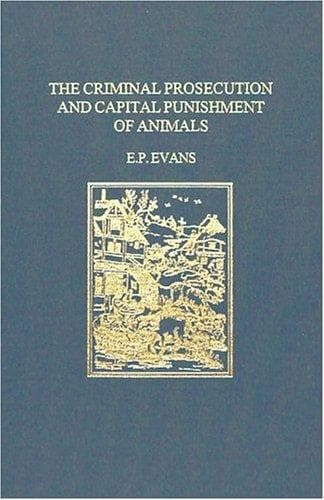
The Criminal Prosecution and Capital Punishment of AnimalsEvans, E. P. (Edward Payson)
History
The Criminal Prosecution and Capital Punishment of Animals
Evans, E. P. (Edward Payson)
Animals -- Law and legislation -- History; Animals, Prosecution and punishment of -- History; Trials -- Europe
by forces as fixed and free from his control as are those which render him
blue-eyed or snub-nosed.
The penological application of this philosophical principle has given rise
to numerous theories concerning the nature and origin of crime. Lombroso
and his disciples, as we have already intimated, attribute it to atavism
or the survival in the individual of the animal instincts and low morals
of the aboriginal barbarian. The criminal is simply a savage let loose in
a civilized community and ignoring the ethical conceptions developed by
ages of culture and performing actions that would have seemed perfectly
proper and praiseworthy in the eyes of our pre-historic ancestors. The
hero of the Palæolithic age is the brigand and cut-throat of to-day. The
criminal type is nothing but a reversion to the primitive type of the
race, and the representatives of this school of anthropologists have been
untiring in their efforts to discover physical and moral characteristics
common to both: long arms like chimpanzees, four circumvolutions of the
frontal lobes of the brain like the large carnivora, small cranial
capacity like the cave-men, canine teeth like anthropoid apes and a simian
nose. This analogy extends to the eyes, the ears, the hair, and even to
the internal organs, the liver, the heart and the stomach, and the
diseases by which they are affected. It has also been observed that
assassins are brachycephalous and thieves dolichocephalous. Marro
maintains that in many cases metaphors express real facts and embody the
common conclusions of mankind based upon centuries of observation:
swindlers have a foxy look, long-fingered persons are naturally thievish,
whereas a club-fisted fellow is pretty sure to have a pugnacious
disposition, and to be a born rough. Nevertheless social surroundings,
educational influences and other outward circumstances are important
factors, not so much in changing the character as in giving it direction;
the same cerebral constitution and consequent innate predisposition may
make a man a hero or a bravo, a dashing soldier like Phil Sheridan, or a
daring robber like Fra Diavolo, according to the place of his birth and
the nature of his environment.
Public-domain text, read in full here on John Shaqi.
Reviews
Reviews
No reviews yet
Be the first to share your thoughts on this work.
Elsewhere in the archive
Join the Discussion
Join the discussion
Sign in to leave a comment or review.
Sign InorCreate an account