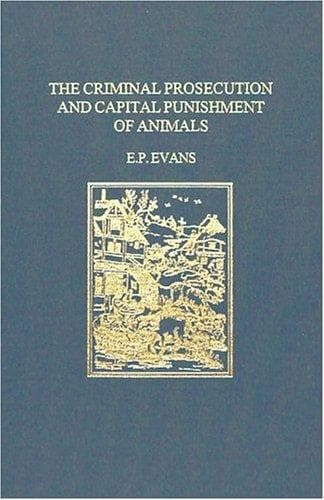
The Criminal Prosecution and Capital Punishment of AnimalsEvans, E. P. (Edward Payson)
History
The Criminal Prosecution and Capital Punishment of Animals
Evans, E. P. (Edward Payson)
Animals -- Law and legislation -- History; Animals, Prosecution and punishment of -- History; Trials -- Europe
Lombroso discovers in habitual malefactors a tendency to tattoo their
bodies; but this kind of cuticular ornamentation indicates merely a low
development of the æsthetic sense, a barbarous conception of the beautiful
or what would be called bad taste, and has not the slightest genetic or
symptomatic connection with crime and the proclivity to perpetrate it. As
a means of embellishing the exterior man it may be rude and unrefined, but
after all it is only skin-deep, and does not extend to the moral
character. Honest people of the lower classes take pleasure in disfiguring
themselves in this way, and soldiers and sailors, who are very far from
furnishing the largest percentage of criminals, are especially addicted to
it, simply because they find ample leisure in the barracks and the
forecastle to undergo this slow and painful process of what they deem
adornment. According to Lombroso criminals have as a rule thick heads of
hair and thin beards; but as the majority of them are comparatively young,
these phenomena are by no means remarkable. He has also found that the
hair of such persons is usually black or dark chestnut; had his
investigations been carried on in Norway and Sweden instead of in Italy,
he would have certainly come to the conclusion that flaxen hair is an
index of a criminal character.
It would be difficult to deny the existence of a constitutionally criminal
class, a persistently perverse element, which is the born foe of all law
and order, at war with every form of social and political organization and
whose permanent attitude of mind is that of the Irishman, who, on landing
in New York, inquired: “Have ye a government here?” and, on receiving an
affirmative answer, replied, “Then I’m agin’ it.” Criminal anthropologists
have been especially earnest in their endeavours to define this pernicious
type and to determine the physiological and physiognomical features, which
characterize and constitute it. This line of research is unquestionably in
the right direction, but as a reaction against barren scholastic
speculations and brutal penal codes has been carried to excess by
enthusiastic specialists and led to broad generalizations and hasty
deductions from insufficient data. Taine’s definition of man as “an animal
of a higher species, that produces poems and systems of philosophy, as
silkworms spin cocoons and bees secrete honeycomb,” applies with equal
force to the vicious side of human nature. Criminal propensities, as well
as creative powers, are the resultants of race, temperament, climate,
food, organism, environment and other pre-natal and post-natal influences
and agencies, to which the individual did not voluntarily subject himself
and from which he cannot escape. The acts, therefore, which he performs,
whether good or evil, are as independent of his will as the colour of his
hair or the shape of his nose; for while they are apparently volitional
impulses, the will itself, from which they seem to proceed, is determined
Public-domain text, read in full here on John Shaqi.
Reviews
Reviews
No reviews yet
Be the first to share your thoughts on this work.
Elsewhere in the archive
Join the Discussion
Join the discussion
Sign in to leave a comment or review.
Sign InorCreate an account