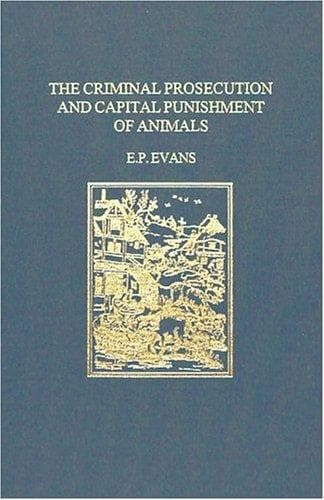
The Criminal Prosecution and Capital Punishment of AnimalsEvans, E. P. (Edward Payson)
History
The Criminal Prosecution and Capital Punishment of Animals
Evans, E. P. (Edward Payson)
Animals -- Law and legislation -- History; Animals, Prosecution and punishment of -- History; Trials -- Europe
irrational methods now employed for the suppression of crime tend directly
to increase it. It is the aim of the positive, in distinction from the
classical school of criminalists to discover the real causes of criminal
actions, and thus to endeavour to eradicate or neutralize them. A casual
criminal, for example, whom external conditions, accidental circumstances,
sudden temptations or bad influences have led astray, should not be
treated in the same manner, although guilty of the same overt act, as the
habitual or constitutional criminal, whose wrong-doing arises from a
diseased, ill-balanced or undeveloped mental or physical organization, and
is therefore an inborn and perhaps irresistible proclivity. The latter is
hardly responsible for his conduct, and the possibility of reforming him
is slight. The only proper thing to do with such a culprit is to render
him personally harmless to society either by death or perpetual
incarceration, and to prevent him from propagating his kind. The law of
the survival of the fittest through selection suggests as its necessary
sequence the suppression of the unfittest through sterilization. Nature
has her own effective and relentless method of attaining this desirable
result; but man is constantly thwarting her beneficent purposes by all
sorts of pernicious schemes originating in factitious sentimentalism and
maudlin sympathy, which under the plea of philanthropy tend to foster and
perpetuate moral monstrosities to the discomfort and detriment of
civilized society and the permanent deterioration of the race. To sentence
persons of this class to eight or ten years’ imprisonment and then to turn
them loose again as a constant source of peril to mankind, is the greatest
folly that any tribunal can possibly commit. It is a wrong done both to
the criminal and to the community of which he is a member. The penalties
imposed by the law should be determined not solely by the enormity of the
crime, but chiefly by the character of the criminal. Paradoxical as such
a conclusion may be, it is nevertheless a strictly logical deduction from
the premises, that the more corrupt he is by his physical constitution and
therefore the less culpable he is from a moral point of view, the more
severe should be the sentence pronounced upon him. Where the vicious
propensity is in the blood and beyond the reach of moral or penal
purgations, the only safety is in the elimination of the individual, just
as the only remedy for a gangrened limb is amputation. We ridicule ancient
and mediæval courts of justice for prosecuting bugs and beasts, but future
generations will condemn as equally absurd and outrageous our judicial
treatment of human beings, who can no more help perpetrating deeds of
violence, under given conditions, than locusts and caterpillars can help
consuming crops to the injury of the husbandman, or wild beasts can help
rending and devouring their prey. It is also interesting to know that in
Public-domain text, read in full here on John Shaqi.
Reviews
Reviews
No reviews yet
Be the first to share your thoughts on this work.
Elsewhere in the archive
Join the Discussion
Join the discussion
Sign in to leave a comment or review.
Sign InorCreate an account