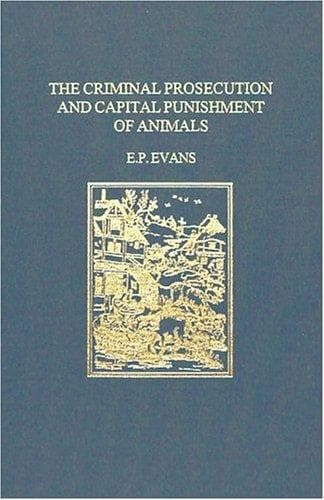
The Criminal Prosecution and Capital Punishment of AnimalsEvans, E. P. (Edward Payson)
History
The Criminal Prosecution and Capital Punishment of Animals
Evans, E. P. (Edward Payson)
Animals -- Law and legislation -- History; Animals, Prosecution and punishment of -- History; Trials -- Europe
former times the animal was not punished capitally because it was supposed
to have incurred guilt, but as a memorial of the occurrence, or in the
language of canonical law: _Non propter culpam sed propter memoriam facti
pecus occiditur_. It was put to death not because it was culpable, but
because it was harmful; and this is the ground on which the radical wing
of criminal anthropologists would repress and eliminate a vicious person
without regard to his mental soundness or moral responsibility; to use
Garofalo’s metaphor he is a microbe injurious to the social organism and
must be destroyed.
Lombroso carries his theory of the innateness, hereditability and
ineradicableness of criminal propensities so far as to affirm that
“education cannot change those who are born with perverse instincts,” and
to despair of correcting an obstinate bias of this sort even in a child.
In accordance with this idea his disciple, Le Bon, proposes to “deport to
distant countries all professional criminals or persistent relapsers into
vice (_récidivistes_) together with their posterity,” and would thus
practically revive the barbarous principle of visiting the sins of the
fathers upon the children, although he does not regard their conduct as
sinful in the sense of being a voluntary transgression of the moral law,
but as the result of a transmitted taint and organic deficiency, for which
the individual is in no wise responsible. It is hardly necessary to add
that this doctrine is not sustained by the statistics of reformatories,
houses of refuge and similar institutions, which have now taken the place
of the prison and the scaffold in the case of juvenile offenders.
Public-domain text, read in full here on John Shaqi.
Reviews
Reviews
No reviews yet
Be the first to share your thoughts on this work.
Elsewhere in the archive
Join the Discussion
Join the discussion
Sign in to leave a comment or review.
Sign InorCreate an account