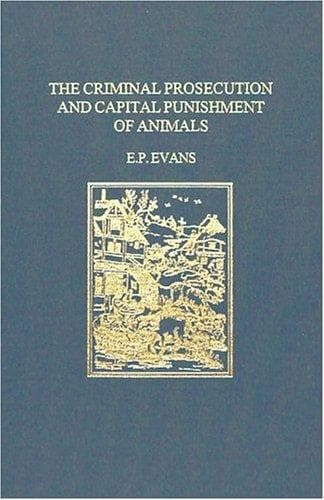
The Criminal Prosecution and Capital Punishment of AnimalsEvans, E. P. (Edward Payson)
History
The Criminal Prosecution and Capital Punishment of Animals
Evans, E. P. (Edward Payson)
Animals -- Law and legislation -- History; Animals, Prosecution and punishment of -- History; Trials -- Europe
It is a curious coincidence that the theory of evolution, in its
application to man’s free agency, should arrive at essentially the same
conclusion as the theology of Augustine and Calvin. Predestination, which
the suffragan of Hippo and the Genevan divine attributed to the arbitrary
decrees of God, evolution traces to the influences of heredity upon
individuals, predetermining their bodily and mental constitutions. There
is, however, a wide difference between these two doctrines in their
workings. From the clutch of a deity “willing to show his wrath and to
make his power known,” no man can by any effort of his own effect his
escape. Against this imperious and general sentence of damnation no
process of development, no upward striving, no individual initiative can
be of any avail. Evolution, on the contrary, promises a gradual release
from low ancestral conditions--the original sin of the theologians--and
opens up to the race a way of redemption, not only through natural
selection and spontaneous variations resulting in higher and nobler types
of mankind, but also through the modification of inherited traits by
careful breeding, thorough discipline and the conscious and constant
endeavour of every human being to improve and perfect himself. Salvation
through the “election of grace” is by no means identical with salvation
through the “survival of the fittest.” The righteousness of those whom God
has chosen as “the vessels of mercy whom he had afore prepared unto
glory,” may be and probably is “as filthy rags”; evolutionary science, on
the contrary, recognizes and appreciates redeemable qualities by
selecting, strengthening and propagating them and by this means aims
ultimately to redeem the world. It imposes upon each man the duty and
necessity of working out his own salvation, not with fear and trembling at
the prospect of meeting an angry deity, but with hope and cheerfulness,
knowing that the beneficent forces of nature are working in him, as in
all forms of organic life, in obedience to the laws of development,
towards the goal of his highest possible perfection by gradually
eliminating the heirloom of the beast and the savage, and letting the
instincts of the tiger and the ape slowly die within him. “The best man,”
said Socrates, “is he who seeks most earnestly to perfect himself, and the
happiest man is he who has the fullest consciousness that he is perfecting
himself.” This utterance of the Athenian sage expresses the fundamental
principle of the ethics of evolution, according to which there can be no
greater sin than the neglect of self-culture, holding, as it does, in the
province of science a place corresponding in importance to that which the
unpardonable sin against the Holy Ghost holds in the province of theology.
No one is blamable for inheriting bad tendencies; but every one is
blamable for not striving to eradicate them. If evil impulses prove to be
irresistible, then society must step in and render them harmless by
Public-domain text, read in full here on John Shaqi.
Reviews
Reviews
No reviews yet
Be the first to share your thoughts on this work.
Elsewhere in the archive
Join the Discussion
Join the discussion
Sign in to leave a comment or review.
Sign InorCreate an account