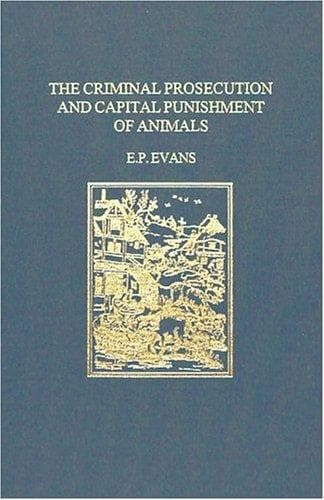
The Criminal Prosecution and Capital Punishment of AnimalsEvans, E. P. (Edward Payson)
History
The Criminal Prosecution and Capital Punishment of Animals
Evans, E. P. (Edward Payson)
Animals -- Law and legislation -- History; Animals, Prosecution and punishment of -- History; Trials -- Europe
depriving of life or liberty the unfortunate victims of such propensities.
Again, if the mental and moral qualities of the lower animals differ from
those of man, not in kind, but only in degree, and the human mammal is
descended from a stock of primates, to which apes and bats belong, and
dogs and cats and pigs are more remotely akin, it is difficult to
determine the point at which moral and penal responsibility ceases in the
descending, or begins in the ascending scale of being. That beasts and
birds and even insects commit acts of violence, which in human agents
would be called crimes, and which spring from the same psychical causes
and, as we have shown in another work (_Evolutionary Ethics and Animal
Psychology._ New York: D. Appleton and Co.; London: William Heinemann,
1898), are punished by the herd, the flock or the swarm in a more or less
judicial manner, is undeniable. The zoöpsychologist Lacassagne divides the
criminal offences of animals into six classes or categories, the ground of
the classification being the motives which underlie and originate them.
The lowest or most rudimentary motive to crime in both man and beast is
hunger, the operation of which is seen in the spectacle of one savage
killing another in order to get sole possession of a wild beast slain by
them in common, and in the ferocity of two dogs fighting over a bone.
Perhaps the great majority of crimes afflicting society at the present
time have their origin in this source. Next to the desire of the
individual to preserve himself comes the desire to preserve his kind; this
motive is commonly considered a more generous impulse and is praised as
parental affection. This earliest and most primitive of altruistic
emotions is exceedingly strong in the lower animals, especially in those
whose offspring are comparatively helpless in infancy, as is the case
with all species of monkeys, and manifests itself not only in tender care
of the young, but also in theft, robbery, and other acts of violence
committed for their sake. The wanton love of destruction characterizes
both beasts and men; there are roughs and vandals among the former as well
as among the latter, who take a malicious delight in doing injury to
persons and property. Vanity and the desire of “showing off” play no small
part in the wrongdoings of apes and apish men and women. Other incentives
to crime are ambition, sexual passion, gregariousness, the concentrated
egoism and merciless brutality of a crowd even in the most civilized
communities, the outrages so recklessly perpetrated by what a French
jurist, M. Tarde, calls “that impulsive and maniac beast, the mob.” It may
be remarked, too, that the kinds of criminal actions, which civilization
tends to diminish among men, domestication tends to diminish among the
lower animals.
Public-domain text, read in full here on John Shaqi.
Reviews
Reviews
No reviews yet
Be the first to share your thoughts on this work.
Elsewhere in the archive
Join the Discussion
Join the discussion
Sign in to leave a comment or review.
Sign InorCreate an account