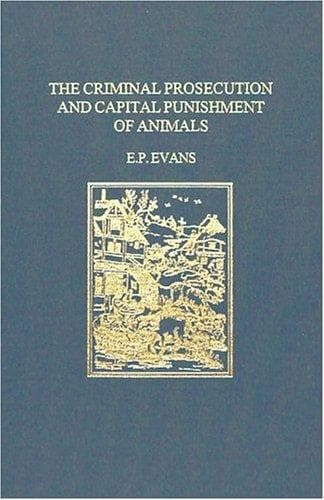
The Criminal Prosecution and Capital Punishment of AnimalsEvans, E. P. (Edward Payson)
History
The Criminal Prosecution and Capital Punishment of Animals
Evans, E. P. (Edward Payson)
Animals -- Law and legislation -- History; Animals, Prosecution and punishment of -- History; Trials -- Europe
In the commission of this monotonous series of diabolical crimes, the
culprit does not seem to have been animated either by animosity or
cupidity. On the contrary, she always showed the warmest affection for her
victims, and nursed them with the tenderest care and the most untiring
devotion, as she watched the distressful workings of the fatal draught;
nor did she derive the slightest material benefit from her course of
conduct, but rather suffered considerable pecuniary loss by the death of
her patients. The testimony of physicians and alienists furnished no
evidence of insanity, nor did she show any signs of atavistic reversion,
physiological abnormity or hereditary homicidal bent. Monomaniacs usually
act fitfully and impulsively; but Marie Jeanneret always manifested the
coolest premeditation and self-possession, never exhibiting the least
hesitation or confusion, or the faintest trace of hallucination, but
answered with the greatest clearness and calmness every question put by
the president of the court. Even M. Turrettini, the prosecuting attorney,
in presenting the case to the jury, was unable to discover any rational
principle on which to explain the conduct and urge the conviction of the
accused; and after exhausting the common category of hypotheses and
showing the inadequacy of each, he was driven by sheer stress of
inexplicability to seek a motive in “_l’espèce de volupté qu’elle
éprouverait à commettre un crime_,” or what, in less elegant, but more
vigorous Western vernacular, would be called “pure cussedness.” Not only
was such an explanation merely a circumlocutory confession of ignorance,
but it was wholly inconsistent with the general character of the indictee.
Indeed, the persistent and pitiless perpetration of this one sort of crime
by this woman, under circumstances which should have excited compassion in
the hardest human heart, seems more like the working of some baneful and
irrepressible force in nature, or the relentless operation of a
destructive machine, than like the voluntary action of a free and
responsible moral agent. M. Zurlinden, the counsel for the defendant,
dwelt with emphasis upon this mysterious phase of the case and thus saved
his client from the scaffold. The jury, after five hours’ deliberation,
rendered a verdict of “Guilty, with extenuating circumstances,” as the
result of which the accused was sentenced to twenty years’ hard labour.
As a matter of fact, there were no circumstances of an extenuating
character except the utter inability of the jurors to discover any motive
for the commission of such a succession of cold-blooded atrocities.
Public-domain text, read in full here on John Shaqi.
Reviews
Reviews
No reviews yet
Be the first to share your thoughts on this work.
Elsewhere in the archive
Join the Discussion
Join the discussion
Sign in to leave a comment or review.
Sign InorCreate an account