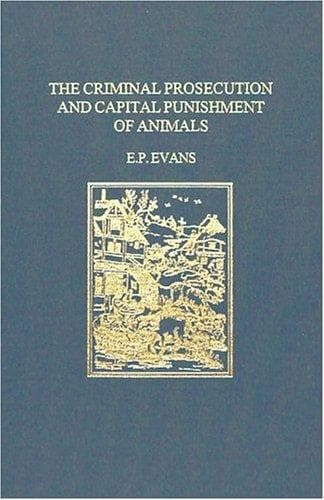
The Criminal Prosecution and Capital Punishment of AnimalsEvans, E. P. (Edward Payson)
History
The Criminal Prosecution and Capital Punishment of Animals
Evans, E. P. (Edward Payson)
Animals -- Law and legislation -- History; Animals, Prosecution and punishment of -- History; Trials -- Europe
After fifteen years’ imprisonment the convict died. During this whole
period of incarceration she not only showed great intelligence and strict
integrity, but was also remarkably kind and helpful to all with whom she
came in contact. She instructed her fellow-convicts in needle-work and
fine embroidery, loved to attend them in sickness, and by her general
influence raised very perceptibly the tone of morals in the workhouse. If
it be true, as asserted by Mynheer Heymanns, one of the latest expounders
of Schopenhauer’s ethics, that “a man is responsible for his actions only
so far as his character finds expression in them, and is to be judged
solely by his character,” what shall be done in cases like the
afore-mentioned, in which the criminal conduct is exceptional, and so far
from being symptomatic of the general character stands out as an isolated
and ugly excrescence and appalling abnormity? According to this theory
crime is to be punished only when it is the natural outgrowth and
legitimate fruit of the criminal’s individuality and society is to be left
unprotected against all maleficence not traceable to such an origin.
There can be hardly any doubt that the Swiss nurse was a toxicomaniac and
that she had become infatuated with poisons, partly by watching their
effects on her own system, and partly by reading about their properties in
medical and botanical works, to the study of which she was passionately
devoted. Did not Mithridates, if we may believe the statements of Galen,
experiment with poisons on living persons? Why should she not follow such
an illustrious example, especially as she never hesitated to take herself
the potions she administered to others; the only difference being that
habit had made her, like the famous King of Pontus, proof against their
venom. She often attempted analyses of these substances, and in one
instance was severely burned by the bursting of a crucible, in which she
was endeavouring to obtain atropine from atropa belladonna or deadly
nightshade. It was this terrible poison, which is endowed with exceedingly
energetic qualities and is therefore used by physicians with extreme
precaution, that seems to have had an irresistible fascination for her,
growing into an insane desire to discover and test its occult virtues. She
had read and heard of zealous scientists and illustrious physicians, who
had experimented on themselves and on their disciples, and become the
benefactors of mankind; why then should she not adopt the same method in
the pursuit of truth and use for this purpose the physiological material
which her profession placed in her hands?
Public-domain text, read in full here on John Shaqi.
Reviews
Reviews
No reviews yet
Be the first to share your thoughts on this work.
Elsewhere in the archive
Join the Discussion
Join the discussion
Sign in to leave a comment or review.
Sign InorCreate an account