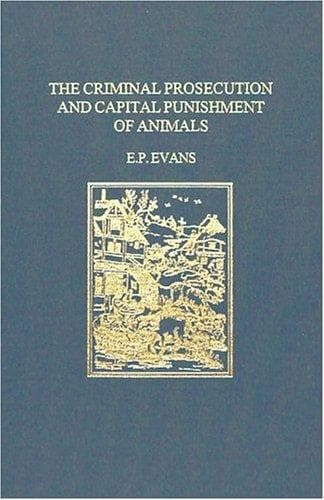
The Criminal Prosecution and Capital Punishment of AnimalsEvans, E. P. (Edward Payson)
History
The Criminal Prosecution and Capital Punishment of Animals
Evans, E. P. (Edward Payson)
Animals -- Law and legislation -- History; Animals, Prosecution and punishment of -- History; Trials -- Europe
If it could be conclusively proved or even rendered highly probable, that
the capital punishment of an ox, which had gored a man to death, deterred
other oxen from pushing with their horns, it would be the unquestionable
right and imperative duty of our legislatures and tribunals to re-enact
and execute the old Mosaic law on this subject. In like manner, if it can
be satisfactorily shown that the hanging of an admittedly insane person,
who has committed murder, prevents other insane persons from perpetrating
the same crime, or tends to diminish the number of those who go insane in
the same direction, it is clearly the duty of society to hang such
persons, whatever may be the opinion of the alienist concerning their
moral responsibility. Nor is this merely a hypothetical case or purely
academical question. It is a well-established fact, that the partially
insane, especially those affected with “moral insanity” or so-called
“cranks,” have their intelligence intact, and are capable of exercising
their reasoning powers freely and fully in laying their plans and in
carrying out their designs. Indeed, criminals of this class are sometimes
known to have entertained the thought that they would be acquitted on the
ground of insanity, and have thereby been emboldened to do the deed; and
it is by no means impossible, but highly probable, that a belief in the
certainty of punishment would have acted as an effective deterrent. A case
of this kind occurred in 1894 in England, where an inmate of a lunatic
asylum deliberately murdered a lawyer, who was visiting the institution.
The murderer declared that he had no grudge against his victim, but
believed himself to be persecuted in general and wished to call attention
to his wrongs by assassinating some official or prominent person. His
method of redress was that of the ordinary anarchist; and his confession
that he would not have dared to commit the act unless he had believed that
as a certificated lunatic under confinement he ran no risk of being
hanged, illustrates the point in question. There can be no doubt, for
example, that the execution of Guiteau for the assassination of Garfield
has greatly lessened the dangers of this kind to which the President of
the United States is exposed; just as the swift and severe punishment of
the Chicago anarchists has dampened the zeal and restrained the activity
of the fanatics, who labour under the delusion that, in a free country,
dynamite bombs are the fittest means of disseminating reformatory ideas
and bringing about the social and political regeneration of the world.
Public-domain text, read in full here on John Shaqi.
Reviews
Reviews
No reviews yet
Be the first to share your thoughts on this work.
Elsewhere in the archive
Join the Discussion
Join the discussion
Sign in to leave a comment or review.
Sign InorCreate an account