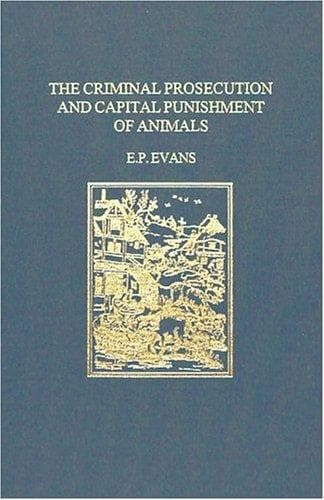
The Criminal Prosecution and Capital Punishment of AnimalsEvans, E. P. (Edward Payson)
History
The Criminal Prosecution and Capital Punishment of Animals
Evans, E. P. (Edward Payson)
Animals -- Law and legislation -- History; Animals, Prosecution and punishment of -- History; Trials -- Europe
From this point of view it is hardly necessary to remark upon the
absurdity of Lombroso’s assertion that the jurists, who formerly condemned
and punished animals, were more logical and consistent than those who now
pass sentence of death on cretins like Grandi or cranks (_grafomani
matteschi_) like Passannante and Guiteau (_Archivio di Psichiatria._
Torino, 1881, Vol. II. Fasc. IV.), since he utterly ignores the preventive
character and purpose of judicial punishment and its practical utility in
checking the homicidal propensities of such persons, whereas the criminal
prosecution and capital punishment of a pig for infanticide will not have
the slightest effect in preventing other pigs from mangling and devouring
little children.
That animals might be deterred from doing violence to men by putting one
of their kind to death and suspending its body as a scarecrow is
maintained by a distinguished writer in the first half of the sixteenth
century, Hierolymus Rosarius, the nuntius of Pope Clement VII. to the
court of Ferdinand I., then King of Hungary, who states that in Africa
crucified lions are placed near towns, and that other lions, however
hungry they may be, are kept away through fear of the same punishment:
_cujus pœnæ metu, licet urgeat fames, desinunt_. He records also that in
riding from Cologne towards Düren, he and his companions saw in the vast
forest two wolves in brogans hanging on a gallows, just like two thieves,
as a warning to the rest of the pack: “Et nos ab Agrippina Colonia Duram
versus equitantes in illa vasta silva, vidimus duos caligatos lupos non
secus quam duos latrones, furcæ suspensos; _quo similis pœnæ formidine a
maleficio reliqui deterreantur_.” In like manner the American farmer sets
up a dead hawk as a deterrent for the protection of his hens. We may add
that Rosarius entertained a high opinion of the intelligence and moral
character of animals and wrote a book to prove their frequent superiority
to men in the use of their rational faculties. This very clever and
original work entitled: _Quod animalia bruta sæpe ratione utantur melius
homine_, was first published by Gabriel Naudé at Paris in 1648; an
enlarged edition was issued by Ribow at Helmstedt in 1728, with a
dissertation on the soul in animals.
Public-domain text, read in full here on John Shaqi.
Reviews
Reviews
No reviews yet
Be the first to share your thoughts on this work.
Elsewhere in the archive
Join the Discussion
Join the discussion
Sign in to leave a comment or review.
Sign InorCreate an account