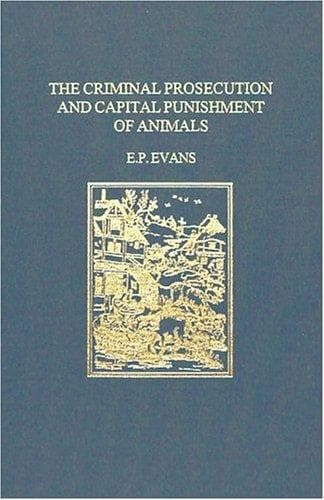
The Criminal Prosecution and Capital Punishment of AnimalsEvans, E. P. (Edward Payson)
History
The Criminal Prosecution and Capital Punishment of Animals
Evans, E. P. (Edward Payson)
Animals -- Law and legislation -- History; Animals, Prosecution and punishment of -- History; Trials -- Europe
In the class of ill-poised minds, yclept cranks, just mentioned, the
spirit of imitation is peculiarly strong and morbidly contagious. The
celebrated psychiater, Baron Von Feuchtersleben, in his treatise _On the
Diatetics of the Soul_, cites the case of a French soldier, who shot
himself in a sentry-box; soon afterwards, several other soldiers took
their lives in the same manner and in the same place. Napoleon I. ordered
the sentry-box to be burned and thus put an end to the suicides. A similar
instance is recorded by Max Simon in his _Hygiène de l’esprit_, in which
he states that a workman hanged himself in the embrasure of a gate, and
his example was followed directly by a dozen of his fellows, so that it
was found necessary to wall up the gate in order to stop this strange
epidemic. The same effect is produced by popular romances, in which the
hero or heroine or both together dispose of themselves in this way;
sometimes whole communities are thus infected by a single work of fiction;
perhaps the most notable case of this kind in modern literature is the era
of sentimentalism and suicidism which followed the publication of Goethe’s
_Werther_. It is well known, too, that another class of sensational
novels, the plots of which consist in the development of criminal
intrigues, tend to promote crime by rendering it fascinating and
indicating an attractive and exciting method of perpetrating it. We have a
recent and very striking instance of this kind in the origin and evolution
of the notorious Dreyfus affair. In June 1893, a year and a half before
the arrest of Dreyfus, a novel entitled _Les Deux Frères_, by Louis
Letang, appeared in the Paris _Petit Journal_, the plot of which may be
concisely described as follows. A young and capable officer, Captain
Philippe Dormelles, who holds a position of confidence in the French
department of war, is envied and hated by two colleagues named Aurélien
and Daniel. Their enmity and jealousy finally become so intense that they
conspire to effect his ruin by accusing him of selling to a foreign power
the secrets of the national defence. It is arranged that a compromising
letter imitating the handwriting of Dormelles and addressed to a foreign
military _attaché_ shall be placed in the secret archives, where it will
fall into the hands of the head of the department Lieutenant-Colonel
Alleward. Dormelles is arrested and thrown into the prison Cherche-Midi,
and at the same time Daniel causes a violent article to be inserted in a
newspaper _Le Vigilant_, charging him with high treason, and seeking to
excite public opinion against him. This article concludes with the false
statement that a search in Dormelles’ department had led to the discovery
of important documents referring to the fabrication of smokeless powder,
and that thereupon Dormelles had confessed his guilt. He is then sentenced
to the galleys, but his betrothed is convinced of his innocence and
finally succeeds in detecting and exposing the forgeries.
Public-domain text, read in full here on John Shaqi.
Reviews
Reviews
No reviews yet
Be the first to share your thoughts on this work.
Elsewhere in the archive
Join the Discussion
Join the discussion
Sign in to leave a comment or review.
Sign InorCreate an account