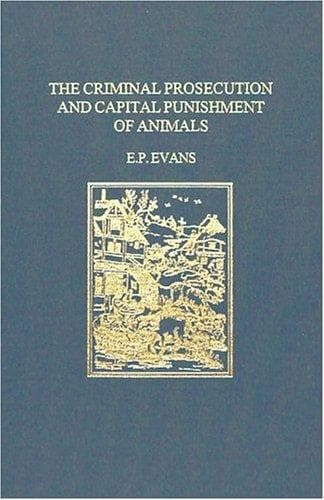
The Criminal Prosecution and Capital Punishment of AnimalsEvans, E. P. (Edward Payson)
History
The Criminal Prosecution and Capital Punishment of Animals
Evans, E. P. (Edward Payson)
Animals -- Law and legislation -- History; Animals, Prosecution and punishment of -- History; Trials -- Europe
same body to take like summary measures in order to get rid of a pest of
rodents. In 1729, 1730 and 1749 the municipal council of Lucerne ordered
processions to be made on St. Magnus’ Day from the Church of St. Francis
to Peter’s Chapel for the purpose of expelling weevils. This custom was
observed annually from 1749 to 1798. The pompous ceremony has been
superseded in Protestant countries by an officially appointed day of
fasting and prayer.
In his “First Counsel” Chassenée not only treats of methods of procedure,
and gives forms of plaints to be drawn up and tendered to the tribunal by
the injured party, as well as useful hints to the pettifogger in the
exercise of his tortuous and tricky profession, but he also discusses many
legal principles touching the jurisdiction of courts, the functions of
judges, and other characteristic questions of civil, criminal, and
canonical law. Animals, he says, should be tried by ecclesiastical
tribunals, except in cases where the penalty involves the shedding of
blood. An ecclesiastical judge is not competent _in causa sanguinis_, and
can impose only canonical punishments, although he may have jurisdiction
in temporal matters and punish crimes not involving a capital sentence.
[_Nam judex ecclesiasticus in causa sanguinis non est competens judex,
licet habeat jurisdictionem in temporalibus et possit crimina poenam
sanguinis non existentia_ (_exigentia_ is obviously the correct reading)
_castigare_. Cons. prim. IV. § 5.] For this reason the Church never
condemned heretics to death, but, having decided that they should die,
gave them over to the secular power for formal condemnation, usually under
the hollow and hypocritical pretence of recommending them to mercy. In the
prosecution of animals the summons was commonly published from the parish
pulpit and the whole judicial process bore a distinctively ecclesiastical
character. In most cases the presiding judge or official was the vicar of
the parish acting as the deputy of the bishop of the diocese. Occasionally
the curate officiated in this capacity. Sometimes the trial was conducted
before a civil magistrate under the authority of the Church, or the matter
was submitted to the adjudication of a conjurer, who, however, appointed
two proctors to plead respectively for the plaintiff and the defendant and
who rendered his verdict in due legal form. Indeed, the word “conjurer”
seems to have been used as a popular designation of the person, whether
priest or layman, who exercised judicatory functions in such trials,
probably because, as a rule, the sentence could be executed only by
conjuration or the invocation of supernatural aid.
Public-domain text, read in full here on John Shaqi.
Reviews
Reviews
No reviews yet
Be the first to share your thoughts on this work.
Join the Discussion
Join the discussion
Sign in to leave a comment or review.
Sign InorCreate an account