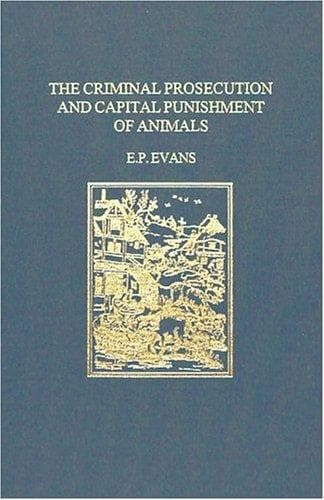
The Criminal Prosecution and Capital Punishment of AnimalsEvans, E. P. (Edward Payson)
History
The Criminal Prosecution and Capital Punishment of Animals
Evans, E. P. (Edward Payson)
Animals -- Law and legislation -- History; Animals, Prosecution and punishment of -- History; Trials -- Europe
The Savoyan jurist, Gaspard Bailly, in the second part of the disquisition
entitled _Traité des Monitoires_, already mentioned, treats “Of the
Excellence of Monitories” and discusses the main points touching the
criminal prosecution and punishment of insects. He begins by saying that
“one should not contemn monitories (a general term for anathemas, bans and
excommunications), seeing that they are matters of great importance,
inasmuch as they bear with them the deadliest sword, wielded by our holy
mother, the Church, to wit, the power of excommunication, which cutteth
the dry wood and the green, sparing neither the quick nor the dead, and
smiting not only rational beings, but turning its edge also against
irrational creatures; since it hath been shown at sundry times and in
divers places, that worms and insects, which were devouring the fruits of
the earth, have been excommunicated and, in obedience to the commands of
the Church, have withdrawn from the cultivated fields to the places
prescribed by the bishop who had been appointed to adjudge and to adjure
them.”
M. Bailly then cites numerous instances of this kind, in which a writer on
logic would find ample illustrations of the fallacy known as _post hoc,
ergo propter hoc_. Thus in the latter half of the fifteenth century,
during the reign of Charles the Bold, Duke of Burgundy, a plague of
locusts threatened the province of Mantua in Northern Italy with famine,
but were dispersed by excommunication. He quotes some florid lines from
the poet Altiat descriptive of these devastating swarms, which “came,
after so many other woes, under the leadership of Eurus (_i.e._ brought by
the east wind), more destructive than the hordes of Attila or the camps of
Corsicans, devouring the hay, the millet and the corn, and leaving only
vain wishes, where the hopes of August stood.” Again in 1541, a cloud of
locusts fell upon Lombardy, and by destroying the crops, caused many
persons to perish with hunger. These insects “were as long as a man’s
finger, with large heads and bellies filled with vileness; and when dead
they infected the air and gave forth a stench, which even carrion kites
and carnivorous beasts could not endure.” Another instance is given, in
which swarms of four-winged insects came from Tartary, identified in the
popular mind with Tartarus, obscuring the sun in their flight and covering
the plains of Poland a cubit deep. In the year 1338, on St. Bartholomew’s
Day, these creatures began to devastate the region round Botzen in the
Tyrol, consuming the crops and laying eggs and leaving a numerous progeny,
which seemed destined to continue the work of destruction indefinitely. A
prosecution was therefore instituted against them before the
ecclesiastical court at Kaltern, a large market-town about ten miles south
of Botzen, then as now famous for its wines, and the parish priest
instructed to proceed against them with the sentence of excommunication in
accordance with the verdict of the tribunal.
Public-domain text, read in full here on John Shaqi.
Reviews
Reviews
No reviews yet
Be the first to share your thoughts on this work.
Elsewhere in the archive
Join the Discussion
Join the discussion
Sign in to leave a comment or review.
Sign InorCreate an account