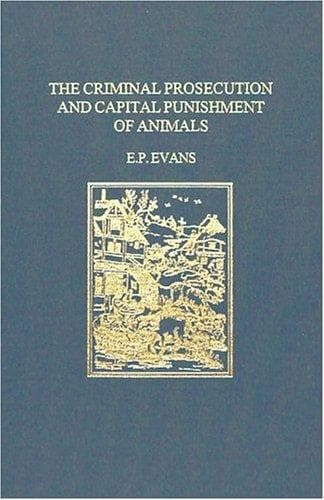
The Criminal Prosecution and Capital Punishment of AnimalsEvans, E. P. (Edward Payson)
History
The Criminal Prosecution and Capital Punishment of Animals
Evans, E. P. (Edward Payson)
Animals -- Law and legislation -- History; Animals, Prosecution and punishment of -- History; Trials -- Europe
This he did by the solemn
ceremony of “inch of candle,” and anathematized them “in the name of the
Blessed Trinity, Father, Son and Holy Ghost.” Owing to the sins of the
people and their remissness in the matter of tithes the devouring insects
resisted for a time the power of the Church, but finally disappeared.
Under the reign of Lotharius II., early in the twelfth century, enormous
quantities of locusts, “having six wings with two teeth harder than flint”
and “darkening the sky and whitening the air like a snowstorm,” laid waste
the most fertile provinces of France. Many of them perished in the rivers
and the sea, and being washed ashore sent forth a putrescent smell and
produced a fearful pestilence. Precisely the same phenomenon, with like
disastrous results, is described by St. Augustine in the last book of _De
Civitate Dei_ as having occurred in Africa and caused the death of 800,000
persons.
In the majority of cases adduced there is no evidence that the Church
intervened at all with its fulminations, and, even when the anathema was
pronounced, the insects appear to have departed of their own free-will
after having eaten up every green thing and reduced the inhabitants to
the verge of starvation; and yet M. Bailly, supposed to be a man of
judicial mind, disciplined by study, accustomed to reason and to know what
sound reasoning is, goes on giving accounts of such scourges, as though
they proved in some mysterious way the effectiveness of ecclesiastical
excommunications and formed a cumulative argument in support of such
claims.
The most important portion of M. Bailly’s work is that in which he shows
how actions of this kind should be brought and conducted, with specimens
of plaints, pleas, replications, rejoinders, and decisions. First in order
comes the petition of the inhabitants seeking redress (_requeste des
habitans_), which is followed in regular succession by the declaration or
plea of the inhabitants (_plaidoyer des habitans_), the defensive
allegation or plea for the insects (_plaidoyer pour les insectes_), the
replication of the inhabitants (_réplique des habitans_), the rejoinder of
the defendant (_réplique du defendeur_), the conclusions of the bishop’s
proctor (_conclusions du procureur episcopal_), and the sentence of the
ecclesiastical judge (_sentence du juge d’église_), which is solemnly
pronounced in Latin. The pleadings on both sides are delivered in French
and richly interlarded with classical allusions and Latin quotations,
being even more heavily weighted with the spoils of erudition than the set
speech of a member of the British Parliament.
The following abridgment of the plea, in which the prosecuting attorney
sets forth the cause of complaint, is a fair specimen of the forensic
eloquence displayed on such occasions:
Public-domain text, read in full here on John Shaqi.
Reviews
Reviews
No reviews yet
Be the first to share your thoughts on this work.
Elsewhere in the archive
Join the Discussion
Join the discussion
Sign in to leave a comment or review.
Sign InorCreate an account