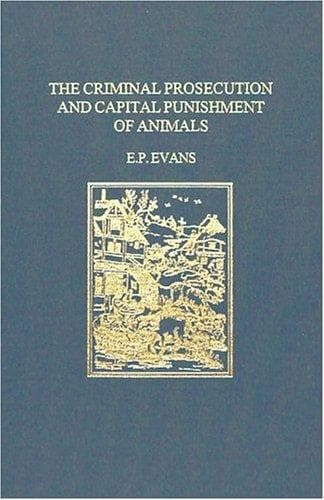
The Criminal Prosecution and Capital Punishment of AnimalsEvans, E. P. (Edward Payson)
History
The Criminal Prosecution and Capital Punishment of Animals
Evans, E. P. (Edward Payson)
Animals -- Law and legislation -- History; Animals, Prosecution and punishment of -- History; Trials -- Europe
“Furthermore, it is illicit to do that which is nugatory and of non-effect
(_qui ne porte coup_); in this respect justice is like nature, which, as
the philosopher affirms, does nothing _mal à propos_ or in vain: _Deus
enim et Natura nihil operantur frustra_. Now I leave it to you to decide
whether anything could be more futile than to summon these irrational
creatures, which can neither speak for themselves, nor appoint proxies to
defend their cause; still less are they able to present memorials stating
grounds of their justification. If then, as I have shown, the summons,
which is the basis of all judicial action, is null and void, the
proceedings dependent upon it will not be able to stand: _cum enim
principalis causa non consistat, neque ea quae consequuntur locum
habent_.”
The counsel for the defence rests his argument, of which the extract just
given may suffice as a sample, upon the irrationality and consequent
irresponsibility of his clients. For this reason he maintains that the
judge cannot appoint a procurator to represent them, and cites legal
authorities to show that the incompetency of the principal implies the
incompetency of the proxy, in conformity with the maxim: _quod directe
fieri prohibetur, per indirectum concedi non debet_. In like manner the
invalidity of the summons bars any charge of contempt of court and
condemnation for contumacy. Furthermore, the very nature of
excommunication is such that it cannot be pronounced against them, since
it is defined as _extra ecclesiam positio, vel è qualibet communione, vel
quolibet legitimo actu separatio_. But these animals cannot be expelled
from the Church, because they are not members of it and do not fall under
its jurisdiction, as the apostle Paul says: “Ye judge them that are
within and not them also that are without.” _Excommunicatio afficit
animam, non corpus, nisi per quandam consequentiam, cujus medicina est._
The animal soul, not being immortal, cannot be affected by such sentence,
which involves the loss of eternal salvation (_quae vergit in dispendium
aeternae salutis_).
Public-domain text, read in full here on John Shaqi.
Reviews
Reviews
No reviews yet
Be the first to share your thoughts on this work.
Elsewhere in the archive
Join the Discussion
Join the discussion
Sign in to leave a comment or review.
Sign InorCreate an account