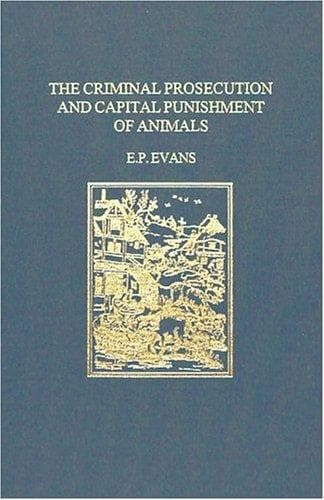
The Criminal Prosecution and Capital Punishment of AnimalsEvans, E. P. (Edward Payson)
History
The Criminal Prosecution and Capital Punishment of Animals
Evans, E. P. (Edward Payson)
Animals -- Law and legislation -- History; Animals, Prosecution and punishment of -- History; Trials -- Europe
“Gentlemen, inasmuch as you have chosen me to defend these little beasts
(_bestioles_), I shall, an it please you, endeavour to right them and to
show that the manner of proceeding against them is invalid and void. I
confess that I am greatly astonished at the treatment they have been
subjected to and at the charges brought against them, as though they had
committed some crime. Thus information has been procured touching the
damage said to have been done by them; they have been summoned to appear
before this court to answer for their conduct, and, since they are
notoriously dumb, the judge, wishing that they should not suffer wrong on
account of this defect, has appointed an advocate to speak in their behalf
and to set forth in conformity with right and justice the reasons, which
they themselves are unable to allege.
“Since you have permitted me to appear in defence of these poor animals, I
will state, in the first place, that the summons served on them is null
and void, having been issued against beasts, which cannot and ought not to
be cited before this judgment seat, inasmuch as such a procedure implies
that the parties summoned are endowed with reason and volition and are
therefore capable of committing crime. That this is not the case with
these creatures is clear from the paragraph _Si quadrupes_, etc., in the
first book of the Pandects, where we find these words: _Nec enim potest
animal injuriam fecisse, quod sensu caret_.
“The second ground, on which I base the defence of my clients, is that no
one can be judicially summoned without cause, and whoever has had such a
summons served renders himself liable to the penalty prescribed by the
statute _De poen. tem. litig._ As regards these animals there is no _causa
justa litigandi_; they are not bound in any manner, _non tenentur ex
contractu_, being incompetent to make contracts or to enter into any
compact or covenant whatsoever, _neque ex quasi contractu_, _neque ex
stipulatione_, _neque ex pacto_, and still less _ex delicto seu quasi_,
can there be any question of a delict or any semblance thereof, since, as
has just been shown, the rational faculties essential to the capability of
committing criminal actions are wanting.
Public-domain text, read in full here on John Shaqi.
Reviews
Reviews
No reviews yet
Be the first to share your thoughts on this work.
Elsewhere in the archive
Join the Discussion
Join the discussion
Sign in to leave a comment or review.
Sign InorCreate an account