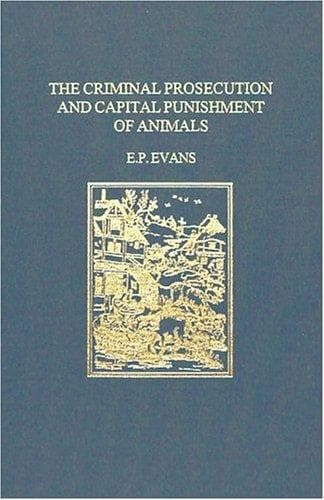
The Criminal Prosecution and Capital Punishment of AnimalsEvans, E. P. (Edward Payson)
History
The Criminal Prosecution and Capital Punishment of Animals
Evans, E. P. (Edward Payson)
Animals -- Law and legislation -- History; Animals, Prosecution and punishment of -- History; Trials -- Europe
“To affirm that such animals cannot be anathematized and excommunicated is
to doubt the authority conferred by God upon his dear spouse, the Church,
whom he has made the sovereign of the whole world, having, in the words of
the Psalmist, put all things under her feet, all sheep and oxen, the
beasts of the field, the fowl of the air, the fish of the sea and
whatsoever passeth through the paths of the seas. Guided by the Holy
Spirit she does nothing unwisely; and if there is anything in which she
should show forth her power it is in protecting and preserving the most
perfect work of her heavenly husband, to wit, man, who was made in the
divine image and likeness.” The orator then dilates on the grandeur and
glory of man and interlards his harangue with quotations from sacred and
profane writers, Moses, Paul, Pliny, Ovid, Silius Italicus and Pico di
Mirandola, and declares that nothing could be more absurd than to deprive
such a being of the fruits of the earth for the sake of “vile and paltry
vermin.” In reply to the statement of Thomas Aquinas, quoted by the
counsel for the defence, that it is futile to curse animals as such, the
plaintiffs’ advocate says that they are not viewed merely as animals, but
as creatures doing harm to man by eating and wasting the products of the
soil designed for human sustenance; in other words he ascribes to them a
certain diabolical character. “But why dwell upon this point, since
besides the instances recorded in Holy Writ, in which God curses inanimate
things and irrational creatures, we have an infinite number of examples of
holy men, who have excommunicated noxious animals. It will suffice to
mention one familiar to us all and constantly before our eyes in the town
of Aix, where St. Hugon, Bishop of Grenoble, excommunicated the serpents,
which infested the warm baths and killed many of the inhabitants by biting
them. Now it is well known, that if the serpents in that place or in the
immediate vicinity bite any one, the bite is no longer fatal. The venom of
the reptile was stayed and annulled by virtue of the excommunication, so
that no hurt ensues from the bite, although the bite of the same kind of
serpent outside of the region affected by the ban, is followed by death.”
Public-domain text, read in full here on John Shaqi.
Reviews
Reviews
No reviews yet
Be the first to share your thoughts on this work.
Elsewhere in the archive
Join the Discussion
Join the discussion
Sign in to leave a comment or review.
Sign InorCreate an account