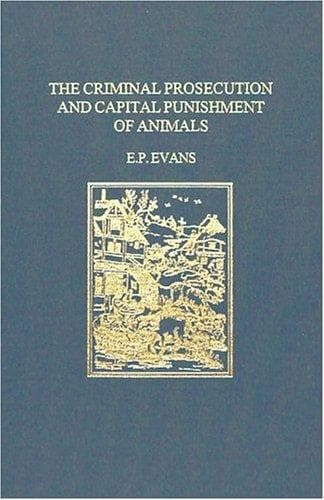
The Criminal Prosecution and Capital Punishment of AnimalsEvans, E. P. (Edward Payson)
History
The Criminal Prosecution and Capital Punishment of Animals
Evans, E. P. (Edward Payson)
Animals -- Law and legislation -- History; Animals, Prosecution and punishment of -- History; Trials -- Europe
That serpents and other poisonous reptiles could be deprived of their
venom by enchantment and thus rendered harmless is in accord with the
teachings of the Bible. Thus we read in Ecclesiastes (x. 11): “Surely the
serpent will bite without enchantment,” _i.e._ unless it be enchanted and
its bite disenvenomed. A curious superstition concerning the adder is
referred to in the Psalms (lviii. 4, 5), where the wicked are said to be
“like the deaf adder that stoppeth her ear; which will not hearken to the
voice of charmers, charming never so wisely.” The Lord is also represented
by Jeremiah (viii. 17) as threatening to “send serpents, cockatrices,
among you, which will not be charmed, and they shall bite you.” It does
not seem to have occurred to the prosecutor that the defendants might be
locusts, which would not be excommunicated.
The objection that God has sent these insects as a scourge, and that to
anathematize them would be to fight against him, is met by saying that to
have recourse to the offices of the Church is an act of religion, which
does not resist, but humbly recognizes the divine will and makes use of
the means appointed for averting the divine wrath and securing the divine
favour.
After the advocates had finished their pleadings, the case was summed up
by the episcopal procurator substantially as follows:
“The arguments offered by the counsel for the defence against the
proceedings instituted by the inhabitants as complainants are worthy of
careful consideration and deserve to be examined soberly and maturely,
because the bolt of excommunication should not be hurled recklessly and at
random (_à la volée_), being a weapon of such peculiar energy and activity
that, if it fails to strike the object against which it is hurled, it
returns to smite him, who hurled it.” [This notion that an anathema is a
dangerous missile to him who hurls it unlawfully or for an unjust purpose,
retroacting like an Australian boomerang, survives in the homely proverb:
“Curses, like chickens, come home to roost.”] The bishop’s proctor reviews
the speeches of the lawyers, but seems to have his brains somewhat muddled
by them. “It is truly a deep sea,” he says, “in which it is impossible to
touch bottom. We cannot tell why God has sent these animals to devour the
fruits of the earth; this is for us a sealed book (_lettres closes_).” He
suggests it may be “because the people turn a deaf ear to the poor begging
at their doors,” and goes off into a long eulogy on the beauty of charity,
with an anthology of extracts from various writers in praise of
alms-giving, among which is one from Eusebius descriptive of hell as a
cold region, where the wailing and gnashing of teeth are attributed to
the torments of eternal frost instead of everlasting fire (_liberaberis ab
illo frigore, in quo erit fletus et stridor dentium_). Again, the plague
of insects may be due to irreverence shown in the churches, which, he
Public-domain text, read in full here on John Shaqi.
Reviews
Reviews
No reviews yet
Be the first to share your thoughts on this work.
Elsewhere in the archive
Join the Discussion
Join the discussion
Sign in to leave a comment or review.
Sign InorCreate an account