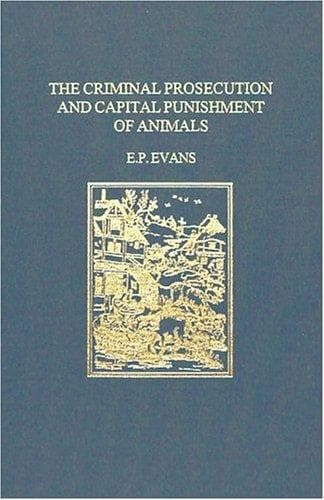
The Criminal Prosecution and Capital Punishment of AnimalsEvans, E. P. (Edward Payson)
History
The Criminal Prosecution and Capital Punishment of Animals
Evans, E. P. (Edward Payson)
Animals -- Law and legislation -- History; Animals, Prosecution and punishment of -- History; Trials -- Europe
adornment of the magnificent mausoleum in which they were sepulchred. His
heirs-at-law contested the will, which was declared null and void by the
court on the ground that “a subject deprived of individuality or of civil
personality” could not inherit. The same principle would apply to the
infliction of penalties upon such subjects. The only kind of legacy that
will cause a man’s memory to be cherished is the form of bequest which
makes the public weal his legatee. The Chinese still hold to the barbarous
custom of bringing corpses to trial and passing sentence upon them. On the
6th of August, 1888, the cadaver of a salt-smuggler, who was wounded in
the capture and died in prison, was brought before the criminal court in
Shanghai and condemned to be beheaded. This sentence was carried out by
the proper officers on the place of execution outside of the west gate of
the city.
Felix Hemmerlein, better known as Malleolus, a distinguished doctor of
canon law and proto-martyr of religious reform in Switzerland, states in
his _Tractatus de Exorcismis_, that in the fourteenth century the peasants
of the Electorate of Mayence brought a complaint against some Spanish
flies, which were accordingly cited to appear at a specified time and
answer for their conduct; but “in consideration of their small size and
the fact that they had not yet reached their majority,” the judge
appointed for them a curator, who “defended them with great dignity”; and,
although he was unable to prevent the banishment of his wards, he obtained
for them the use of a piece of land, to which they were permitted
peaceably to retire. How they were induced to go into this insect
reservation and to remain there we are not informed. The Church, as
already stated, claimed to possess the power of effecting the desired
migration by means of her ban. If the insects disappeared, she received
full credit for accomplishing it; if not, the failure was due to the sins
of the people; in either case the prestige of the Church was preserved and
her authority left unimpaired.
Public-domain text, read in full here on John Shaqi.
Reviews
Reviews
No reviews yet
Be the first to share your thoughts on this work.
Elsewhere in the archive
Join the Discussion
Join the discussion
Sign in to leave a comment or review.
Sign InorCreate an account