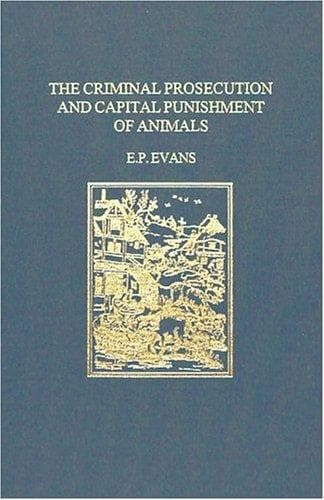
The Criminal Prosecution and Capital Punishment of AnimalsEvans, E. P. (Edward Payson)
History
The Criminal Prosecution and Capital Punishment of Animals
Evans, E. P. (Edward Payson)
Animals -- Law and legislation -- History; Animals, Prosecution and punishment of -- History; Trials -- Europe
More than half-a-century later the Franciscan friars of the cloister of
St. Anthony in the province of Piedade no Maranhão, Brazil, were greatly
annoyed by termites, which devoured their food, destroyed their furniture,
and even threatened to undermine the walls of the monastery. Application
was made to the bishop for an act of interdiction and excommunication, and
the accused were summoned to appear before an ecclesiastical tribunal to
give account of their conduct. The lawyer appointed to defend them urged
the usual plea about their being God’s creatures and therefore entitled to
sustenance, and made a good point in the form of an _argumentum ad
monachum_ by praising the industry of his clients, the white ants, and
declaring them to be in this respect far superior to their prosecutors,
the Gray Friars. He also maintained that the termites were not guilty of
criminal aggression, but were justified in appropriating the fruits of the
fields by the right derived from priority of possession, inasmuch as they
had occupied the land long before the monks came and encroached upon their
domain. The trial lasted for some time and called forth remarkable
displays of legal learning and forensic eloquence, with numerous citations
of sacred and profane authorities on both sides, and ended in a
compromise, by the terms of which the plaintiffs were obliged to provide a
suitable reservation for the defendants, who were commanded to go thither
and to remain henceforth within the prescribed limits. In the chronicles
of the cloister it is recorded, under date of Jan. 1713, that no sooner
was the order of the prelatic judge promulgated by being read officially
before the hills of the termites than they all came out and marched in
columns to the place assigned. The monkish annalist regards this prompt
obedience as conclusive proof that the Almighty endorsed the decision of
the court. [Cited by Emile Angel on the authority of Manoel Bernardes’
_Nova Floresta, ou Sylva de varios apophthegmas e ditos sentencios
espirituaes e moraes_, etc. Vol. V., Lisboá, 1747.]
About the middle of the sixteenth century the inhabitants of several
villages in Aargau were greatly annoyed by swarms of gadflies and
petitioned the Bishop of Constance for relief. In the episcopal rescript,
written and signed by the vidame Georg Winterstetter, the people are
enjoined to abstain from dancing on Sundays and feast days, from all forms
of libidinousness, gambling with cards or dice and other frivolities.
These injunctions are followed by prayer and the usual formulas of
conjuration and exorcism. The original document was written in Latin and
preserved in the archives of Baden in Switzerland, but is now lost. In
1566 the Landamman of Unterwalden, Johannes Wirz, took a German
translation of it home with him to be used in case of need against the
“vergifteten Würmer,” and deposited it in the archives of Obwalden, where
it still remains. It was published in 1898 by Dr. Merz.
Public-domain text, read in full here on John Shaqi.
Reviews
Reviews
No reviews yet
Be the first to share your thoughts on this work.
Elsewhere in the archive
Join the Discussion
Join the discussion
Sign in to leave a comment or review.
Sign InorCreate an account