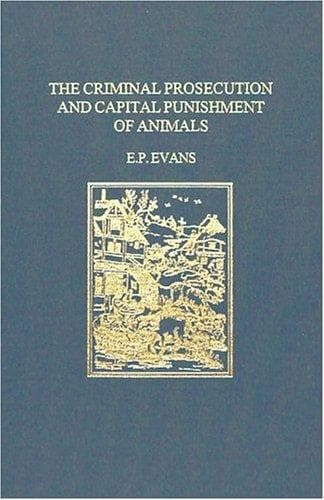
The Criminal Prosecution and Capital Punishment of AnimalsEvans, E. P. (Edward Payson)
History
The Criminal Prosecution and Capital Punishment of Animals
Evans, E. P. (Edward Payson)
Animals -- Law and legislation -- History; Animals, Prosecution and punishment of -- History; Trials -- Europe
In Protestant communities, the priest as exorcist has been superseded, to
a considerable extent, by the professional conjurer, who in some portions
of Europe is still employed to save crops from devouring insects and
similar plagues. A curious instance of this kind is recorded in Görres’
_Historisch-Politische Blätter_ for 1845 (Heft VII. p. 516). A Protestant
gentleman in Westphalia, whose garden was devastated by worms, after
having tried divers vermicidal remedies in vain, resolved to have recourse
to a conjurer. The wizard came and walked about among the vegetables,
touching them with a wand and muttering enchantments. Some workmen, who
were repairing the roof of a stable near by, made fun of this hocus-pocus
and began to throw bits of lime at the conjurer. He requested them to
desist, and finally said: “If you don’t leave me in peace, I shall send
all the worms up on the roof.” This threat only excited the hilarity of
the scoffers, who continued to ridicule and disturb him in his
incantations. Thereupon he went to the nearest hedge, cut a number of
twigs, each about a finger in length, and placed them against the wall of
the stable. Soon the vermin began to abandon the plants and, crawling in
countless numbers over the twigs and up the wall, took complete possession
of the roof. In less than an hour the men were obliged to stop working and
stood in the court below covered with confusion and cabbage-worms.
The writer, who relates this strange incident, fully believes that it
actually occurred, and ascribes it to “the force of human faith and the
magnetic power of a firm will over nature.” This, too, is the theory held
by Paracelsus, who maintained that the effectiveness of a curse lay in the
energy of the will, by which the wish, so to speak, concretes into a deed,
just as anger directs the arm and actualizes itself in a blow. By “fervent
desire” merely, without any physical effort or aggressive act, he deemed
it possible to wound a man’s body or to pierce it through as with a sword.
He also held that brutes are more easily exorcised or accursed than men,
“for the spirit of man resists more than that of the brute.” Similar
notions were entertained nearly a century later by Jacob Boehme, who
defines magic as “doing in the spirit of the will,” an idea which finds
more recent and more scientific expression in Schopenhauer’s doctrine of
“the objectivation of the will.” Indeed, Schopenhauer’s postulate of the
will as the sole energy and actuality in the universe is only the
philosophic statement of an assumption, upon which magicians and
medicine-men, enchanters, exorcists and anathematizers have acted more or
less in all ages. We have a striking illustration of the workings of some
such mysterious, quasi-hyperphysical force in hypnotism, the reality of
which it is no longer possible to deny, however wonderful and
incomprehensible its manifestations may appear.
Public-domain text, read in full here on John Shaqi.
Reviews
Reviews
No reviews yet
Be the first to share your thoughts on this work.
Elsewhere in the archive
Join the Discussion
Join the discussion
Sign in to leave a comment or review.
Sign InorCreate an account