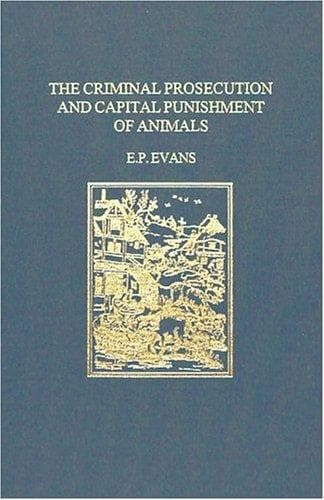
The Criminal Prosecution and Capital Punishment of AnimalsEvans, E. P. (Edward Payson)
History
The Criminal Prosecution and Capital Punishment of Animals
Evans, E. P. (Edward Payson)
Animals -- Law and legislation -- History; Animals, Prosecution and punishment of -- History; Trials -- Europe
Buggery (_offensa cujus nominatio crimen est_, as it is euphemistically
designated in legal documents) was uniformly punished by putting to death
both parties implicated, and usually by burning them alive. The beast,
too, is punished and both are burned (_punitur etiam pecus et ambo
comburuntur_), says Guillielmus Benedictinus, a writer on law, who lived
about the end of the fourteenth century. Thus, in 1546, a man and a cow
were hanged and then burned by order of the parliament of Paris, the
supreme court of France. In 1466, the same tribunal condemned a man and a
sow to be burned at Corbeil. Occasionally interment was substituted for
incremation. Thus in 1609, at Niederrad, a man and a mare were executed
and their bodies buried in the same carrion-pit. On the 12th of September,
1606, the mayor of Loens de Chartres, on complaint of the dean, canons,
and chapter of the cathedral of Chartres, condemned a man named Guillaume
Guyart to be “hanged and strangled on a gibbet in reparation and
punishment of sodomy, whereof the said Guyart is declared accused,
attainted and convicted.” A bitch, his accomplice, was sentenced to be
knocked on the head (_assommée_) by the executioner of high justice and
“the dead bodies of both to be burned and reduced to ashes.” It is
furthermore added that if the said Guyart, who seems to have
contumaciously given leg-bail, cannot be seized and apprehended in person,
the sentence shall, in his case, be executed in effigy by attaching his
likeness in painting to the gibbet. It was also decreed that all the
property of the absconder should be confiscated and the sum of one hundred
and fifty livres be adjudged to the plaintiffs, out of which the costs of
the trial were to be defrayed. (_Vide_ Appendix L.) This disgusting crime
appears to have been very common; at least Ayrault in his _Ordre
Judiciaire_, published in 1606, states that he has many times
(_multoties_) seen brute beasts put to death for this cause. In his
_Magnalia Christi Americana_ (Book VI, (III), London, 1702) Cotton Mather
records that “on June 6, 1662, at New Haven, there was a most
unparalleled wretch, one Potter by name, about sixty years of age,
executed for damnable Bestialities.” He had been a member of the Church
for twenty years and was noted for his piety, “devout in worship, gifted
in prayer, forward in edifying discourse among the religious, and zealous
in reforming the sins of other people.” Yet this monster, who is described
as possessed by an unclean devil, “lived in most infandous Buggeries for
no less than fifty years together, and now at the gallows there were
killed before his eyes a cow, two heifers, three sheep and two sows, with
all of which he had committed his brutalities. His wife had seen him
confounding himself with a bitch ten years before; and he then excused
himself as well as he could, but conjured her to keep it secret.” He
afterwards hanged the bitch, probably as a sort of vicarious atonement.
Public-domain text, read in full here on John Shaqi.
Reviews
Reviews
No reviews yet
Be the first to share your thoughts on this work.
Elsewhere in the archive
Join the Discussion
Join the discussion
Sign in to leave a comment or review.
Sign InorCreate an account