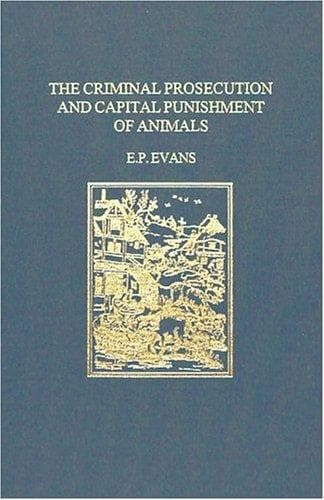
The Criminal Prosecution and Capital Punishment of AnimalsEvans, E. P. (Edward Payson)
History
The Criminal Prosecution and Capital Punishment of Animals
Evans, E. P. (Edward Payson)
Animals -- Law and legislation -- History; Animals, Prosecution and punishment of -- History; Trials -- Europe
According to this account he must have begun to practice sodomy when he
was ten years of age, a vicious precocity which the author would doubtless
explain on the theory of diabolical possession. In 1681, a habitual
sodomite, who had been wont to defile himself with greyhounds, cows,
swine, sheep and all manner of beasts, was brought to trial together with
a mare, at Wünschelburg in Silesia, where both were burned alive. In 1684,
on the 3rd of May, a bugger was beheaded at Ottendorf, and the mare, his
partner in crime, knocked on the head; it was expressly enjoined that in
burning the bodies the man’s should lie underneath that of the beast. In
the following year, fourteen days before Christmas, a journeyman tailor,
“who had committed the unnatural deed of carnal lewdness with a mare,” was
burned at Striga together with the mare.
For the same offence Benjamin Deschauffour was condemned, May 25, 1726, to
be tied to a stake and there burned alive “together with the minutes of
the trial;” his ashes were strewed to the wind and his estates seized and,
after the deduction of a fine of three thousand livres, confiscated to the
benefit of his Majesty. In the case of Jacques Ferron, who was taken in
the act of coition with a she-ass at Vanvres in 1750, and after due
process of law, sentenced to death, the animal was acquitted on the ground
that she was the victim of violence and had not participated in her
master’s crime of her own free-will. The prior of the convent, who also
performed the duties of parish priest, and the principal inhabitants of
the commune of Vanvres signed a certificate stating that they had known
the said she-ass for four years, and that she had always shown herself to
be virtuous and well-behaved both at home and abroad and had never given
occasion of scandal to any one, and that therefore “they were willing to
bear witness that she is in word and deed and in all her habits of life a
most honest creature.” This document, given at Vanvres on Sept. 19, 1750,
and signed by “Pintuel Prieur Curé” and the other attestors, was produced
during the trial and exerted a decisive influence upon the judgment of the
court. As a piece of exculpatory evidence it may be regarded as unique in
the annals of criminal prosecutions.
Public-domain text, read in full here on John Shaqi.
Reviews
Reviews
No reviews yet
Be the first to share your thoughts on this work.
Elsewhere in the archive
Join the Discussion
Join the discussion
Sign in to leave a comment or review.
Sign InorCreate an account