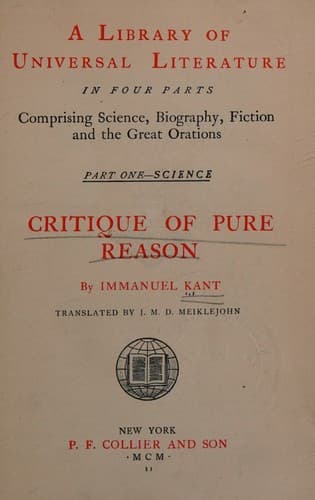
Causation; Knowledge, Theory of; Philosophy, German; Reason
This we can indeed always perceive in ourselves. We cannot cogitate a
geometrical line without drawing it in thought, nor a circle without
describing it, nor represent the three dimensions of space without
drawing three lines from the same point perpendicular to one another.
We cannot even cogitate time, unless, in drawing a straight line (which
is to serve as the external figurative representation of time), we fix
our attention on the act of the synthesis of the manifold, whereby we
determine successively the internal sense, and thus attend also to the
succession of this determination. Motion as an act of the subject (not
as a determination of an object),[20] consequently the synthesis of the
manifold in space, if we make abstraction of space and attend merely to
the act by which we determine the internal sense according to its form,
is that which produces the conception of succession. The understanding,
therefore, does by no means find in the internal sense any such
synthesis of the manifold, but produces it, in that it affects this
sense. At the same time, how “I who think” is distinct from the “i”
which intuites itself (other modes of intuition being cogitable as at
least possible), and yet one and the same with this latter as the same
subject; how, therefore, I am able to say: “I, as an intelligence and
thinking subject, cognize myself as an object thought, so far as I am,
moreover, given to myself in intuition—only, like other phenomena, not
as I am in myself, and as considered by the understanding, but merely
as I appear”—is a question that has in it neither more nor less
difficulty than the question—“How can I be an object to myself?” or
this—“How I can be an object of my own intuition and internal
perceptions?” But that such must be the fact, if we admit that space is
merely a pure form of the phenomena of external sense, can be clearly
proved by the consideration that we cannot represent time, which is not
an object of external intuition, in any other way than under the image
of a line, which we draw in thought, a mode of representation without
which we could not cognize the unity of its dimension, and also that we
are necessitated to take our determination of periods of time, or of
points of time, for all our internal perceptions from the changes which
we perceive in outward things. It follows that we must arrange the
determinations of the internal sense, as phenomena in time, exactly in
the same manner as we arrange those of the external senses in space.
And consequently, if we grant, respecting this latter, that by means of
them we know objects only in so far as we are affected externally, we
must also confess, with regard to the internal sense, that by means of
it we intuite ourselves only as we are internally affected by
ourselves; in other words, as regards internal intuition, we cognize
our own subject only as phenomenon, and not as it is in itself.[21]
Public-domain text, read in full here on John Shaqi.
Reviews
Reviews
No reviews yet
Be the first to share your thoughts on this work.
Elsewhere in the archive
Join the Discussion
Join the discussion
Sign in to leave a comment or review.
Sign InorCreate an account