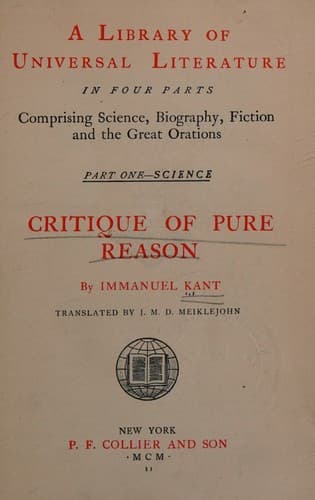
Causation; Knowledge, Theory of; Philosophy, German; Reason
In all subsumptions of an object under a conception, the representation
of the object must be homogeneous with the conception; in other words,
the conception must contain that which is represented in the object to
be subsumed under it. For this is the meaning of the expression: “An
object is contained under a conception.” Thus the empirical conception
of a plate is homogeneous with the pure geometrical conception of a
circle, inasmuch as the roundness which is cogitated in the former is
intuited in the latter.
But pure conceptions of the understanding, when compared with empirical
intuitions, or even with sensuous intuitions in general, are quite
heterogeneous, and never can be discovered in any intuition. How then
is the subsumption of the latter under the former, and consequently the
application of the categories to phenomena, possible?—For it is
impossible to say, for example: “Causality can be intuited through the
senses and is contained in the phenomenon.”—This natural and important
question forms the real cause of the necessity of a transcendental
doctrine of the faculty of judgement, with the purpose, to wit, of
showing how pure conceptions of the understanding can be applied to
phenomena. In all other sciences, where the conceptions by which the
object is thought in the general are not so different and heterogeneous
from those which represent the object in concreto—as it is given, it is
quite unnecessary to institute any special inquiries concerning the
application of the former to the latter.
Now it is quite clear that there must be some third thing, which on the
one side is homogeneous with the category, and with the phenomenon on
the other, and so makes the application of the former to the latter
possible. This mediating representation must be pure (without any
empirical content), and yet must on the one side be intellectual, on
the other sensuous. Such a representation is the transcendental schema.
The conception of the understanding contains pure synthetical unity of
the manifold in general. Time, as the formal condition of the manifold
of the internal sense, consequently of the conjunction of all
representations, contains à priori a manifold in the pure intuition.
Now a transcendental determination of time is so far homogeneous with
the category, which constitutes the unity thereof, that it is universal
and rests upon a rule à priori. On the other hand, it is so far
homogeneous with the phenomenon, inasmuch as time is contained in every
empirical representation of the manifold. Thus an application of the
category to phenomena becomes possible, by means of the transcendental
determination of time, which, as the schema of the conceptions of the
understanding, mediates the subsumption of the latter under the former.
Public-domain text, read in full here on John Shaqi.
Reviews
Reviews
No reviews yet
Be the first to share your thoughts on this work.
Elsewhere in the archive
Join the Discussion
Join the discussion
Sign in to leave a comment or review.
Sign InorCreate an account