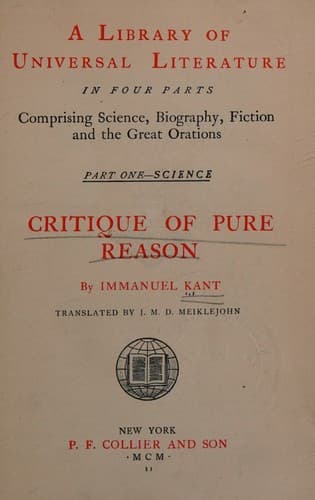
Causation; Knowledge, Theory of; Philosophy, German; Reason
Geometry is a science which determines the properties of space
synthetically, and yet à priori. What, then, must be our representation
of space, in order that such a cognition of it may be possible? It must
be originally intuition, for from a mere conception, no propositions
can be deduced which go out beyond the conception, and yet this happens
in geometry. (Introd. V.) But this intuition must be found in the mind
à priori, that is, before any perception of objects, consequently must
be pure, not empirical, intuition. For geometrical principles are
always apodeictic, that is, united with the consciousness of their
necessity, as: “Space has only three dimensions.” But propositions of
this kind cannot be empirical judgements, nor conclusions from them.
(Introd. II.) Now, how can an external intuition anterior to objects
themselves, and in which our conception of objects can be determined à
priori, exist in the human mind? Obviously not otherwise than in so far
as it has its seat in the subject only, as the formal capacity of the
subject’s being affected by objects, and thereby of obtaining immediate
representation, that is, intuition; consequently, only as the form of
the external sense in general.
Thus it is only by means of our explanation that the possibility of
geometry, as a synthetical science à priori, becomes comprehensible.
Every mode of explanation which does not show us this possibility,
although in appearance it may be similar to ours, can with the utmost
certainty be distinguished from it by these marks.
§ 4. Conclusions from the foregoing Conceptions.
(a) Space does not represent any property of objects as things in
themselves, nor does it represent them in their relations to each
other; in other words, space does not represent to us any determination
of objects such as attaches to the objects themselves, and would
remain, even though all subjective conditions of the intuition were
abstracted. For neither absolute nor relative determinations of objects
can be intuited prior to the existence of the things to which they
belong, and therefore not à priori.
(b) Space is nothing else than the form of all phenomena of the
external sense, that is, the subjective condition of the sensibility,
under which alone external intuition is possible. Now, because the
receptivity or capacity of the subject to be affected by objects
necessarily antecedes all intuitions of these objects, it is easily
understood how the form of all phenomena can be given in the mind
previous to all actual perceptions, therefore à priori, and how it, as
a pure intuition, in which all objects must be determined, can contain
principles of the relations of these objects prior to all experience.
Public-domain text, read in full here on John Shaqi.
Reviews
Reviews
No reviews yet
Be the first to share your thoughts on this work.
Join the Discussion
Join the discussion
Sign in to leave a comment or review.
Sign InorCreate an account