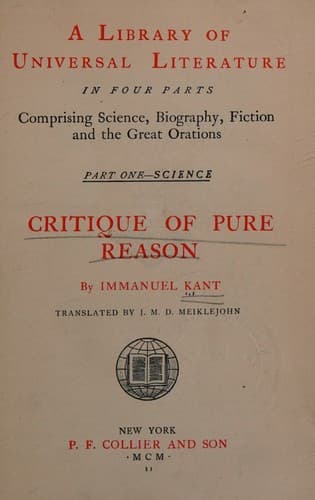
Causation; Knowledge, Theory of; Philosophy, German; Reason
As regards _clearness_, the reader has a right to demand, in the first
place, _discursive_ or logical clearness, that is, on the basis of
conceptions, and, secondly, _intuitive_ or æsthetic clearness, by means
of intuitions, that is, by examples or other modes of illustration _in
concreto_. I have done what I could for the first kind of
intelligibility. This was essential to my purpose; and it thus became
the accidental cause of my inability to do complete justice to the
second requirement. I have been almost always at a loss, during the
progress of this work, how to settle this question. Examples and
illustrations always appeared to me necessary, and, in the first sketch
of the Critique, naturally fell into their proper places. But I very
soon became aware of the magnitude of my task, and the numerous
problems with which I should be engaged; and, as I perceived that this
critical investigation would, even if delivered in the driest
_scholastic_ manner, be far from being brief, I found it unadvisable to
enlarge it still more with examples and explanations, which are
necessary only from a _popular_ point of view. I was induced to take
this course from the consideration also that the present work is not
intended for popular use, that those devoted to science do not require
such helps, although they are always acceptable, and that they would
have materially interfered with my present purpose. Abbé Terrasson
remarks with great justice that, if we estimate the size of a work, not
from the number of its pages, but from the time which we require to
make ourselves master of it, it may be said of many a book—_that it
would be much shorter, if it were not so short_. On the other hand, as
regards the comprehensibility of a system of speculative cognition,
connected under a single principle, we may say with equal justice: many
a book would have been much clearer, if it had not been intended to be
so very clear. For explanations and examples, and other helps to
intelligibility, aid us in the comprehension of _parts_, but they
distract the attention, dissipate the mental power of the reader, and
stand in the way of his forming a clear conception of the _whole;_ as
he cannot attain soon enough to a survey of the system, and the
colouring and embellishments bestowed upon it prevent his observing its
articulation or organization—which is the most important consideration
with him, when he comes to judge of its unity and stability.
Public-domain text, read in full here on John Shaqi.
Reviews
Reviews
No reviews yet
Be the first to share your thoughts on this work.
Join the Discussion
Join the discussion
Sign in to leave a comment or review.
Sign InorCreate an account