India -- History -- British occupation, 1765-1947 -- Fiction; Invalids -- Fiction; Simla (India) -- Fiction
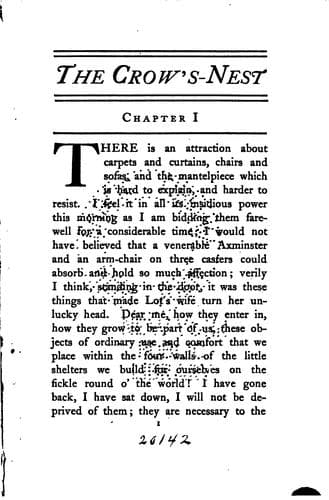
“I have a roof to cover me,” said Thalia sententiously, “and for
that,” she added looking round, “I didn’t know how thankful I was. But
I am undergoing repairs. They are putting mud into the cracks of my
dwelling, paperhangers are impending, and this morning arrived three
whitewashers. I wanted to be done with it at once, so I sent for three.
I told them I was in a hurry. In one breath, they said, it should be
done, and sat down in the verandah _to make their brushes_. It’s a
fact. Of split bamboo. You can _not_ hustle the East. But I found I had
to come away.”
“How foolish it all seems!” I sighed with an eye upon the farther
hills. “Shouldn’t you like to see my pansies?”
“Yes,” she replied resignedly, “I suppose I must see your pansies,” and
where I led she followed me, still babbling of paperhangers.
It is no exaggeration to say that during the months of April, May, and
June, there are more pansies than people in this town. (Upon second
thoughts why should it be an exaggeration, since in every garden
inhabited by two or three persons there are hundreds of pansies.)
They seem to like the official atmosphere, doubtless in being so high
and dry it suits them; at all events they adapt themselves to it with
less fuss than almost any other flower. And certainly they could teach
individuality to most of our worthy bureaucrats, who have a way of
coming up, they, exactly like each other. Pansies from the same parent
root naturally look alike, but if you really scan their features there
is not the least resemblance between families. I have been living
principally in their fellowship for several days and I quite feel
that my knowledge of human nature is extended. There never was such
variety of temperament in any community; to describe it would be to
write a list of all the adjectives yet invented to bear upon character,
a tedious task. It is positively a relief after the slight monotony
of a society in which everybody is paid by the Queen, to meet persons
like pansies, who aren’t paid by anybody, and who express themselves,
in consequence, with the utmost facility and freedom. (Thalia, who is
the wife of the Head of a Department, here interrupted me to ask what I
could possibly mean.) Oh there is no charm like spontaneity, in idea,
behaviour, or looks. The Dodos of London society triumph by it, while
self-conscious people of vast intellectual resources are considered
frumps.
I imparted all this to Thalia, and she agreed with me.
Public-domain text, read in full here on John Shaqi.
Reviews
Reviews
No reviews yet
Be the first to share your thoughts on this work.
Join the Discussion
Join the discussion
Sign in to leave a comment or review.
Sign InorCreate an account