India -- History -- British occupation, 1765-1947 -- Fiction; Invalids -- Fiction; Simla (India) -- Fiction
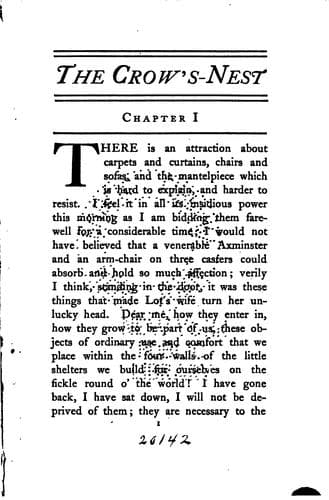
It would be dull at the window but for the discovery I have made in
the banksia over the arched trellis which stands, for no purpose at
all, across the garden walk that runs round the roses. Here I strongly
suspect the brown bird has an establishment, and a sitting hen. So long
as I myself sat in the garden I never guessed it, he was too clever;
but he did not dream, I suppose, that I would take to spying upon him
in ambush like this, and from here his conduct looks most husbandly.
The brown bird joined us one afternoon about a fortnight ago, while
we were having tea on the verandah. He perched on a flower-pot, and
hinted, in the most engaging way, that the ground was baked and worms
were scarce, and we made him feel so welcome to crumbs that he has
constantly dropped in upon us since. He is most venturesome with us;
he will run under our chairs and under the table, and he loves to slip
in and out of hiding among the flower-pots. He goes with little leaps
and bounds, like a squirrel; and he whistles with such melody that one
might very well think him a thrush. I thought him a thrush, until one
afternoon Tiglath-Pileser said aggressively, “I don’t believe that bird
is a thrush.”
“Pray, then,” said I, “what is he?”
“He belongs, nevertheless,” said Tiglath-Pileser judicially, “to the
_Passeres_.”
“If I asked your name,” said Delia, who was there, “I should not be
grateful to be told that you were one of the primates,” and we laughed
at the master of the house.
“Wait a bit,” said he, “I should call him a robin.”
“He’s got no red breast,” I brought forth, out of the depth of my
ignorance.
“He has a reddish spot under each ear,” said Tiglath-Pileser, “and mark
how his tail turns up.”
“I am no ornithologist,” I said. “His tail turns up.”
“How little one realizes,” quoth Thisbe, pensively, “that a bird has
ears.”
“I think,” said Tiglath-Pileser, “that I can decide this matter,” and
disappeared into the house.
“He has gone to get a book,” said Delia, “that will settle _you_, dear
lady, you and your thrush,” and presently he came out triumphant, as
she said, with “Wanderings of a Naturalist in India.”
“‘Although differing altogether in the colour of its plumage from the
European robin,’” he read aloud, “‘there is great similarity in their
habits. It frisks before the door, and picks up crumbs, jerking its
tail as it hops along. How often have associations of home been brought
to mind by seeing this pretty little warbler pursuing its gambols
before the door of an Eastern bungalow!’”
“Well,” said I, “not often, because of course we didn’t recognize it,
but in future they always will be,” and at that moment the pretty
little warbler put himself in profile on the paling before us, and
threw out his little waistcoat, and threw back his little head and
whistled, and we all cried out that he had established his identity,
there could not be any doubt of it, in face of that brave and dainty
attitude. There are some things a bird never could pick up.
Public-domain text, read in full here on John Shaqi.
Reviews
Reviews
No reviews yet
Be the first to share your thoughts on this work.
Elsewhere in the archive
Join the Discussion
Join the discussion
Sign in to leave a comment or review.
Sign InorCreate an account