India -- History -- British occupation, 1765-1947 -- Fiction; Invalids -- Fiction; Simla (India) -- Fiction
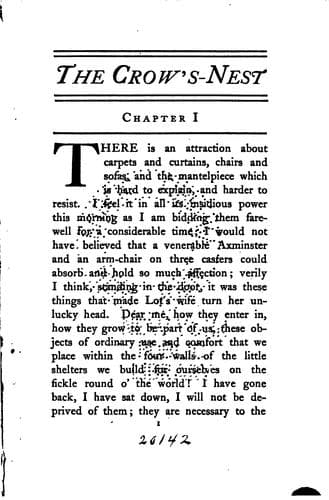
It was not worse than I expected, and it was a little less bad, let
me confess, than I described it to my family. I can now sympathize
with the youthful knight of the middle ages at the end of his first
night’s ghostly vigil in the sanctuary,--if the rest are no worse than
this they can be got through with. I am certainly on better terms with
nature, as he was on better terms with the skeleton in the vault,
apprehending with him in that neither of them was really calculated to
do us any harm. He no doubt lost his superstitions as I am losing my
finer feelings; whether one is sufficiently compensated for them by a
vulgar appetite and a tendency to drowsiness immediately after dinner
is a question I should like to discuss with him.
For one thing I am beginning to make acquaintance with the Days and
to know them apart, not merely as sunny days, dull days, windy days
and wet days, as they are commonly unobserved and divided, but in the
full and abundant personality which every one of the three hundred
and sixty-five offers to the world that rolls under it. To me also,
a very short time ago, the day was a convenient arrangement for
making things visible outside the house, accompanied by agreeable or
disagreeable temperatures; a mere condition monotonously recurrent
and quite subordinated to engagements. To live out here enveloped by
it, dependent on it, in a morning-to-night intimacy with it, is to
know better. The Day is a great elemental creature left in charge of
the world for as long, every twenty-four hours, as she can see it. No
one day is the same as another; those of the same season have only a
family likeness. They express character and temperament, like people,
and if you elect to live with them, to throw yourself, as it were,
upon their better nature with no other protection than an umbrella, it
just makes all the difference. Some were tender and sweet-tempered, I
remember, some were thoughtful, with a touch of gloom, one was artist
with a firm hand and a splendid palette. And among all the seven I did
not dislike a single Day, which is remarkable when one thinks of the
abuse one is so apt to let fall, from the inside of a window, about
what our common little brains call “the weather.” There is no weather,
it is a poor and pointless term, there is only the mood of a day, and
however badly it may serve our paltry ends it is bound at least to be
interesting. When one reflects upon how little this great thing is
regarded and how constantly from behind glass, by miserable men, one is
touched with pity for the ingratitude of the race, and astonishment at
the amount of personal superiority to be acquired in a week. Day unto
day uttereth speech, swinging a lantern; it is the business of night
to wait. Day after day, too spiritual to be pagan, too sensuous to be
divine, speeds out of time into the eternity where planets are served
in turn. Behold, in spite of all their science, I show you a mystery,
Public-domain text, read in full here on John Shaqi.
Reviews
Reviews
No reviews yet
Be the first to share your thoughts on this work.
Join the Discussion
Join the discussion
Sign in to leave a comment or review.
Sign InorCreate an account