In connection with Mr. H. L. Clark, Mr. Conant undertook to
investigate the character of the nervous control of the heart
beat in decapod crustaceans. They selected the common edible
crab, Callinectes hastatus, and made a series of most careful
experiments and dissections which resulted in proving the
existence of one inhibitory nerve and two accelerator nerves
passing to the heart on each side from the thoracic ganglion.
They not only demonstrated the physiological reaction of
these nerves, but traced out successfully their anatomical
course from the ganglion to the pericardial plexus. It seemed
hardly probable from an a priori standpoint that in an animal
like the crab there should be any necessity for an elaborate
nervous mechanism to regulate the beat of the heart, but their
experiments placed the matter beyond any doubt, and have since
served to call attention to this animal as a promising organism
for the study of some of the fundamental problems in the
physiology of the heart. As compared with previous work upon
the same subject it may be said that their experiments are the
most definite and successful that have yet been made.
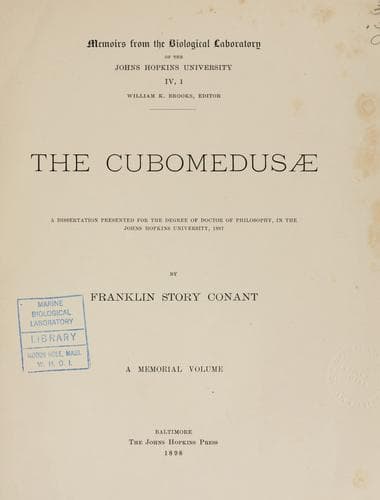
His chief completed work, the Dissertation on The Cubomedusæ, is here
printed; and through it the reader who did not know Conant must decide
whether he was well fitted, by training and by natural endowments, for
advancing knowledge. I myself felt confident that the career on which he
had entered would be full of usefulness and honor. I was delighted when
he was appointed to the Adam T. Bruce Fellowship, for I had discovered
that he was rapidly becoming an inspiring influence among his fellow
students in the laboratory, and I had hoped that we might have him among
us for many years, and that we might enjoy and profit by the riper fruits
of his more mature labors.
Immediately after his examination for the degree of Doctor of Philosophy
in June, 1897, he set out for Jamaica to continue his studies at the
laboratory which this University had established for the summer at Port
Antonio, and he there worked for nearly three months on the development,
and on the physiology of the sense-organs, of the Cubomedusæ.
His notes and specimens are so complete that I hope it will be possible
to complete in Baltimore, at an early day, the work which he had expected
to carry on this year.
After the sudden and alarming death of the director of the expedition,
Dr. J. E. Humphrey, Conant took the burden of responsibility upon
himself, and while he fully appreciated his own great danger, he devoted
himself calmly and methodically to the service of others who, in their
afflictions, needed his help, and he fell in the path of duty, where he
had always walked, leaving behind him a clear and simple account of all
the business of the laboratory and of his scientific work, and of his own
affairs, complete to the day before his death.
Public-domain text, read in full here on John Shaqi.
Reviews
Reviews
No reviews yet
Be the first to share your thoughts on this work.
Join the Discussion
Join the discussion
Sign in to leave a comment or review.
Sign InorCreate an account