Clocks and watches -- Juvenile fiction; Fantasy literature
E-text prepared by Ted Garvin, Chuck Greif, and the Project Gutenberg
Online Distributed Proofreading Team (www.pgdp.net)
Note: Project Gutenberg also has an HTML version of this
file which includes the original illustrations.
See 15569-h.htm or 15569-h.zip:
(https://www.gutenberg.org/dirs/1/5/5/6/15569/15569-h/15569-h.htm)
or
(https://www.gutenberg.org/dirs/1/5/5/6/15569/15569-h.zip)
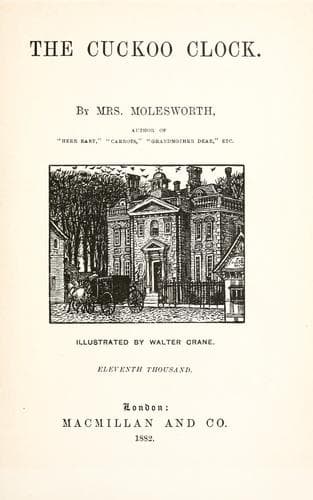
THE CUCKOO CLOCK
by
MRS. MOLESWORTH
Author of "Herr Baby," "Carrots," "Grandmother Dear," etc.
Illustrated by Walter Crane
London:
MacMillan and Co.,
and New York.
1895
[Illustration: IT WAS A LITTLE BOAT.]
[Illustration]
TO
MARY JOSEPHINE,
AND TO THE DEAR MEMORY OF HER BROTHER,
THOMAS GRINDAL,
BOTH FRIENDLY LITTLE CRITICS OF
MY CHILDREN'S STORIES.
Edinburgh, 1877.
CONTENTS
CHAPTER
I. THE OLD HOUSE
II. _IM_PATIENT GRISELDA
III. OBEYING ORDERS
IV. THE COUNTRY OF THE NODDING MANDARINS
V. PICTURES
VI. RUBBED THE WRONG WAY
VII. BUTTERFLY-LAND
VIII. MASTER PHIL
IX. UP AND DOWN THE CHIMNEY
X. THE OTHER SIDE OF THE MOON
XI. "CUCKOO, CUCKOO, GOOD-BYE!"
LIST OF ILLUSTRATIONS.
"WHY WON'T YOU SPEAK TO ME?"
MANDARINS NODDING
"MY AUNTS MUST HAVE COME BACK!"
SHE LOOKED LIKE A FAIRY QUEEN
"WHERE ARE THAT CUCKOO?"
"TIRED! HOW COULD I BE TIRED, CUCKOO?"
IT WAS A LITTLE BOAT
CHAPTER I.
THE OLD HOUSE.
"Somewhat back from the village street
Stands the old-fashioned country seat."
Once upon a time in an old town, in an old street, there stood a very
old house. Such a house as you could hardly find nowadays, however you
searched, for it belonged to a gone-by time--a time now quite passed
away.
It stood in a street, but yet it was not like a town house, for though
the front opened right on to the pavement, the back windows looked out
upon a beautiful, quaintly terraced garden, with old trees growing so
thick and close together that in summer it was like living on the edge
of a forest to be near them; and even in winter the web of their
interlaced branches hid all clear view behind.
There was a colony of rooks in this old garden. Year after year they
held their parliaments and cawed and chattered and fussed; year after
year they built their nests and hatched their eggs; year after year, I
_suppose_, the old ones gradually died off and the young ones took their
place, though, but for knowing this _must_ be so, no one would have
suspected it, for to all appearance the rooks were always the same--ever
and always the same.
Time indeed seemed to stand still in and all about the old house, as if
it and the people who inhabited it had got _so_ old that they could not
get any older, and had outlived the possibility of change.
Public-domain text, read in full here on John Shaqi.
Reviews
Reviews
No reviews yet
Be the first to share your thoughts on this work.
Join the Discussion
Join the discussion
Sign in to leave a comment or review.
Sign InorCreate an account