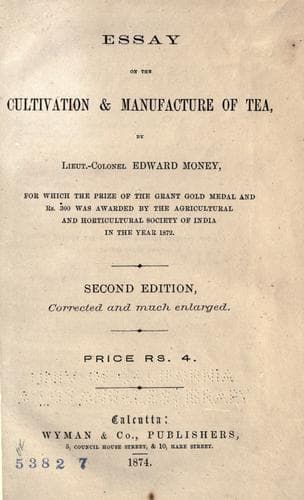
The Cultivation and Manufacture of TeaMoney, Edward
Science
The Cultivation and Manufacture of Tea
Money, Edward
Tea
For a long time it appeared as if this difficulty would be a bar to the
general introduction of Indian Teas in England, and so indeed it would
have proved, had the short-sighted policy adopted at the commencement
by one or two Indian Companies that their Teas should be sold retail
and pure, that is, unmixed with Chinese, been followed out. It did not
avail to tell John Bull it was better Tea, that it was far stronger,
that it was in no way adulterated; for he simply shook his head, the
flavour was different to what use had made him familiar with, and he
would none of it.
But little by little, in spite of the above, it made its way. Grocers
soon found that the worst, _id est_, the weakest class of Chinese Teas
received _body_ and were made saleable by an addition of Indian Tea.
It was not long after this that the trade discovered that pretty well
_all_ Chinese Teas were improved, if proportions of Indian Teas were
mixed with them. In short, the fact was recognised by Tea vendors that
Chinese Teas were weak, and much improved if mixed with Indian.
The public were thus _educated_ to relish the superior flavour of
Indian Tea, and did so, when the quantity mixed with the Chinese was
not so great as to make the new flavour too _prononcé_. Little by
little the custom of so mixing became very general, so much so that it
may almost be said to-day that if Indian Teas cannot be purchased pure,
no more can Chinese. A mixture of Chinese and Indian Tea, the latter
small as compared with the former, is what is now generally used in
Great Britain.
This is the case to-day. What will it be in the future?
As the English palate is educated to like the flavour of Indian Tea,
more and more of it will be demanded in the mixture made up for the
public, and though the day is distant, nay, may never arrive, on
account of its greater cost, when it will be generally drunk pure, I do
not myself doubt that the demand for it will go on steadily increasing
for years to come, as it has for years past.[85]
It is an important query if, with a largely increased demand, the
supply will be equal to it. Very far from all India has a good Tea
climate, which is a peculiar one, and only exists in perfection in
Assam, Cachar, Chittagong, and lands in Bengal close to the foot of the
Himalayas.
But in these districts alone there are lands sufficient to supply
nearly the whole world with Tea, so that it is not the lands which are
wanting, though the Government prices for the lands are prohibitory and
will check cultivation. But in Assam, Cachar, and the Terai below the
Himalayas labour is very scarce, while in Chittagong the area fit for
Tea is not large, so that I do not anticipate any very sudden increase
of the cultivation, though year by year it is on the increase and will
so continue.
Public-domain text, read in full here on John Shaqi.
Reviews
Reviews
No reviews yet
Be the first to share your thoughts on this work.
Elsewhere in the archive
Join the Discussion
Join the discussion
Sign in to leave a comment or review.
Sign InorCreate an account