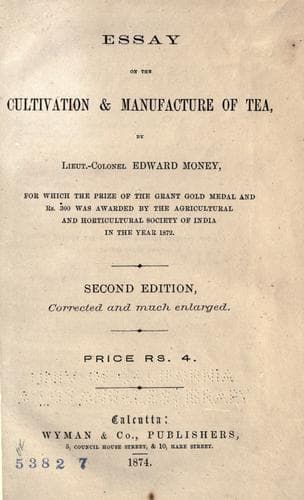
The Cultivation and Manufacture of TeaMoney, Edward
Science
The Cultivation and Manufacture of Tea
Money, Edward
Tea
On the other hand, I do not--for the reasons stated, viz., that
Tea is an acquired taste and thus a new kind is not at first
palatable--anticipate any very sudden increase in the demand. If,
however, I am wrong, and from a largely increased demand the prices of
Indian Teas rise, I do not doubt that the cultivation will be greatly
extended, and that after an interval of four years (it takes that time
for the Tea plant to produce) the supply will be equal to the then
wants of the English market.
The future of Indian Tea is, I think, a bright one, and I know nothing
in which capital can be more profitably invested if the business is
conducted with knowledge and experience, but to embark in it without
these two requisites is ruin.
A few figures may be given here. The imports into Great Britain of
Indian Teas have been yearly increasing, till in 1873 they amounted to
18,367,000 lbs., and, judging from the estimate out here of the produce
this year, viz., 1874, the imports into Great Britain in 1874 will not
be far short of 20,000,000 lbs.[86]
But as the annual consumption of Tea in the United Kingdom is not less
than 130,000,000 lbs., India is still very far from supplying enough to
give a mixture of three-fourths Chinese and one-fourth India Tea.[87]
The finest Chinese Tea sells in London in bond at 2_s._ 4_d._ to 2_s._
6_d._, while the finest Indian in bond fetches 3_s._ to 3_s._ 6_d._[88]
What, then, will be the future of Indian Tea? It is an important query.
The industry is one which, if successful, might attain to wide limits,
and help not a little to relieve the Indian State Exchequer, while it
would afford occupation to many a class of Englishmen who at present
look about in vain for employment.
Tea speculation has passed through the first two preliminary phases
to which most new ventures are liable. First, we had the wild rush,
the mad fever, when every man thought that to own a few Tea bushes
was to realise wealth. In those days existing plantations were bought
at eight and ten times their value; nominal areas of 500 acres were
paid for which, on subsequent measurement, proved to be under 100; new
gardens were commenced on impossible sites, and by men as managers who
not only did not know a Tea plant from a cabbage, but who were equally
ignorant of the commonest rules of agriculture. Boards highly paid,
with secretaries still more liberally remunerated, were formed both in
Calcutta and London to carry on the enterprise; and, in short, money
was lavished in every conceivable way, while mismanagement ran rampant
in each department. It is not strange that the whole thing collapsed:
the wonder is it did not do so earlier.
Public-domain text, read in full here on John Shaqi.
Reviews
Reviews
No reviews yet
Be the first to share your thoughts on this work.
Elsewhere in the archive
Join the Discussion
Join the discussion
Sign in to leave a comment or review.
Sign InorCreate an account