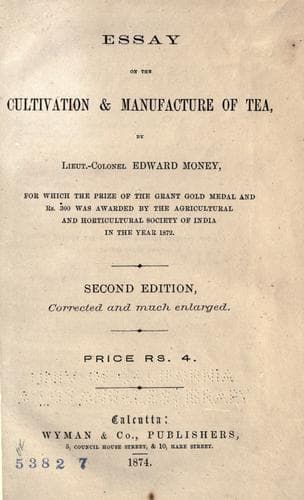
The Cultivation and Manufacture of TeaMoney, Edward
Science
The Cultivation and Manufacture of Tea
Money, Edward
Tea
The Chinese plant gives a small and inferior produce, the indigenous
and hybrid kind a larger and very superior one; thus I think the latter
one of the “necessary conditions for success.” On the other points,
with the exception of manuring, nothing need be said, inasmuch as
their necessity is evident; but on the point of manure I must say a
few words. The Tea plant is being continually denuded of its leaves;
nothing is returned to the soil; and consequently in process of
time that soil is exhausted. It was held once that manure destroyed
the flavour of Tea. This idea, at variance with all agricultural
experience, is now completely exploded, like many others received from
the Chinamen who first came from the Flowery Land to teach the art of
Tea cultivation and Tea manufacture to the Indian public. Many of them
had never perhaps seen a Tea bush, anyhow in many respects theirs was
faulty teaching, and all experienced planters are convinced, and it is
truth, that more knowledge on Tea exists in India than China at the
present time.
But to return to the subject of manure. It is, and is now generally
allowed to be, a necessity to the lengthened and successful maintenance
of a plantation. Means for its production are now largely adopted in
Assam and Cachar, and the results will be a yield per acre the most
sanguine have never dreamt of. Chittagong, on this head, has great
advantages; manure in any quantity can there be procured for a trifle,
and the results have shown its great value.
We have scarcely yet entered on the third stage to which any new
speculation, after the two first (the wild venture, and the unreasoning
panic have passed), tends; but as knowledge of the financial results of
Tea plantations in the hands of private firms and private individuals
increases, that third stage will dawn, if it has not done so already.
It consists in a sober appreciation of the subject opposed to both the
extremely exulting and depressing views passed through, and when it
arrives, the great and successful future of Indian Tea will be only a
question of time.
FOOTNOTES:
[84] Note to Third Edition.--The above three statements, quite true
when written, are not so now. The heavy fall in the value of both
Indian and Chinese Teas in 1877, while pressing hard on the Indian
producer, has certainly had the one good effect for him of making
Indian Teas more widely known. They _are_ generally known now, in many
cases sold pure as Indian Tea, and used by all retail dealers to give
the body, or strength lacking in most Chinese kinds.
Public-domain text, read in full here on John Shaqi.
Reviews
Reviews
No reviews yet
Be the first to share your thoughts on this work.
Elsewhere in the archive
Join the Discussion
Join the discussion
Sign in to leave a comment or review.
Sign InorCreate an account