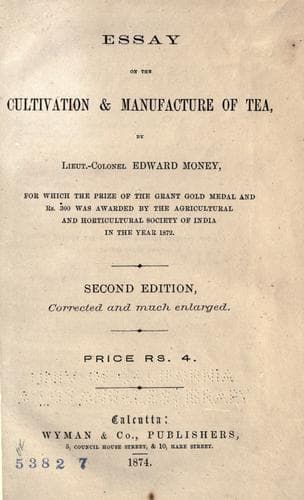
The Cultivation and Manufacture of TeaMoney, Edward
Science
The Cultivation and Manufacture of Tea
Money, Edward
Tea
Successful experiments have been made in this branch of cultivation
in the United States, as is shown by a report just published by
Mr. Jackson, a Scotch gentleman now settled in America, who was at
one time manager of the estates of the Scottish Assam Company. The
Commissioner of Agriculture has, at Mr. Jackson’s advice, selected
a tract of land in Georgia for an experimental farm, on which the
raising of Tea on an extended scale will be carefully and thoroughly
tried. Samples of the Teas already produced by Mr. Jackson have been
sent to Messrs. Thompson, tea merchants, Mincing Lane, London, to be
examined. The reply was that--“They represented Teas of a high type.
The flavour, though not strong, is remarkably fragrant. In appearance
they resemble Indian Tea, but the flavour is more like that of the
finest Chinese black Tea, or of the hill Teas of India.”
No reason why the Teas should not be good, but the labour difficulty
will, I think, prevent Tea paying there, as elsewhere in America, for
Mr. Jackson himself, who continues the above, asks further on, “Can we
afford to pay our labourers four times as much as they pay in India and
still make Tea a success?” He, strange to say, tries to prove “yes.” I
say no, a thousand times no, in spite of all Mr. Jackson says. I like,
however, to give both sides of a question, and so will let Mr. Jackson
speak for himself:--
The stock cry continually raised against Tea culture in this country
is, how can you raise Tea in a country where wages are so high?
You can cultivate Tea at a profit only in a country where labour
is at the lowest possible minimum, and so on. And so it is taken
for granted that the Tea culture is to be allowed to retain its
antiquated forms and systems for all time, and that the skill and
intelligence of a civilized nation can do nothing to raise it to a
level with corresponding branches of agriculture, such, for instance,
as rice growing. What would the people of South Carolina say if
told that the only way to cultivate rice at a profit was to sow all
their seed in nursery beds and, when sprouted, to transplant their
entire crop, seed by seed, by hand, as is done in India? What would
a Minnesota farmer say if told that the only implement with which
he could profitably rear a crop of corn was the hoe, wielded by an
attenuated skeleton of a man? If the hundreds of wealthy Tea planters
in Assam were told that they must return to the original system of
manufacturing their Teas by hand, they would throw up their farms in
despair. Seventy million pounds of Tea are now annually manufactured
by machinery in India and Java, and I have satisfied myself that
green Teas, suitable for the American market, can be manufactured at
one-third the cost of the black Teas prepared by machinery for the
English market. There is but one division of Tea culture into which
Public-domain text, read in full here on John Shaqi.
Reviews
Reviews
No reviews yet
Be the first to share your thoughts on this work.
Elsewhere in the archive
Join the Discussion
Join the discussion
Sign in to leave a comment or review.
Sign InorCreate an account