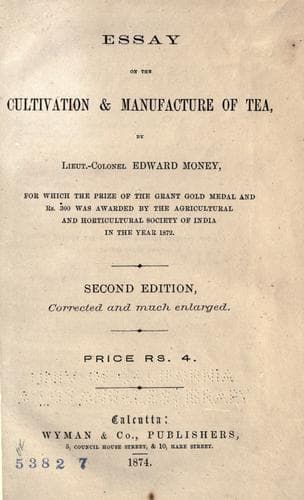
The Cultivation and Manufacture of TeaMoney, Edward
Science
The Cultivation and Manufacture of Tea
Money, Edward
Tea
We have glanced at the past and seen the present condition of the
Tea enterprise. The most important matter is still before us--the
future of Tea in Natal. It must be remembered that an industry may
be profitable to encourage for local consumption, and yet fail when
it comes to be exported. This production (Tea) must be looked at as
one which, if it progresses, must shortly be exported. Three hundred
acres of Tea in full bearing will supply to the full the present need
of the Colony and its surroundings, _i.e._, taking the import returns
as our guide; and even with increasing demand, that demand can soon
be met. Therefore the importance attaching to the question, “Can
we in Natal grow Tea to pay, so as to compete with other countries
in the markets of the world?” The Tea-growing districts of India,
till lately confined to Assam, Cachar, and neighbourhood, have now
been extended to the Neilgherries and Ceylon, and these places,
till lately confining themselves to coffee, are leaving that most
precarious crop and growing Tea and cinchona. Both these districts
at present export Tea to England. It is said that Tea is to be
introduced into Queensland and the northern territory of Australia;
and that the Southern States of the Union and California contemplate
Tea growing. Are we justified, then, in believing that Tea may be
profitably exported from Natal? Before considering this, we have
to bear in mind that Tea is placed in the London market in large
quantities at a very low price; China Teas as low as 5-1/2_d._ per
lb. in bond, and Indian Teas as low as 8_d._ per lb. in bond; but
again the price extends to 3_s._ and even 4_s._ per lb. in bond. All
these things have to be weighed and well considered by anyone before
embarking in this enterprise to any great extent. In all matters of
agriculture the labour question is the foremost, after it is known
that the plant will flourish. To attempt to base the success of this
particular industry upon any other than that of coolie labour would
be foolish, as we all know that Kafirs are not to be relied upon;
therefore the cost of labour has to be considered. We well know
that all the Tea estates of India have to be supplied with imported
coolies--the natives of the districts concerned will not work unless
casually--but the cost of coolies in Natal must be more than the
cost of coolies in Assam--therefore in that item the advantage must
be in favour of the Indian planter. Countries such as Queensland
and the United States of America must either import labour, or pay
a much higher rate than we do; hence so far as these countries are
concerned, Natal will hold its own.
I have not done yet. Here is another place where it seems they mean to
try Tea. I do hope that climate, soil, labour, something will be found
unsuitable.
FIJI TEA.
Public-domain text, read in full here on John Shaqi.
Reviews
Reviews
No reviews yet
Be the first to share your thoughts on this work.
Elsewhere in the archive
Join the Discussion
Join the discussion
Sign in to leave a comment or review.
Sign InorCreate an account