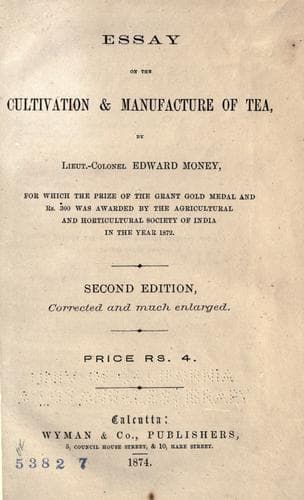
The Cultivation and Manufacture of TeaMoney, Edward
Science
The Cultivation and Manufacture of Tea
Money, Edward
Tea
Mr. J. E. Mason, of the Alpha Tea and Coffee Estate, Taviuni, Fiji,
has forwarded to Mr. J. O. Moody, the expert, of Melbourne, samples
of the first Fijian Tea produced in his part of the world; at the
same time writing that early next year he hoped to pluck off 30 acres
planted with Tea, and that the samples sent were hastily made in a
barrel with a frying-pan of charcoal. Mr. J. O. Moody reports:--“Fiji
Pekoe leaf: Handsome, small, even, golden tipped, evenly and well
fermented. Fiji Pekoe liquor: Very strong, full, rich, and pungent
pekoe flavour, thick, with deep red infusion. An invaluable Tea for
mixing, and worth about 2_s._ 6_d._ per lb. in bond. Fiji Pekoe
Souchong leaf: Well made, wiry, twisted, rich, black tippy leaf,
evenly and well fermented Fiji Pekoe Souchong flavour, with good,
bright, red infusion. A fine Tea to drink alone, and worth about
1_s._ 9_d._ per lb. in bond. These Teas have the character of good
Ceylon growths, and are in every respect suitable Teas for general
consumption, and such samples are sure to meet with ready sale in
Australasia or Great Britain.”
Here again, I am told, the labour question is the doubtful point. Tea
cannot be made to pay without cheap labour, and the sooner all these
new Tea countries learn the lesson the better for the pockets of the
projectors. I may add, the better for the Indian planter’s pocket too,
for _any_ increase in the supply is hurtful.
In closing this chapter, I would give one word of advice to intending
Tea planters in India, or indeed anywhere. There is too much Tea
already, why plant more? If you must “go into Tea” you may do so and
probably make money, but it will not be by _planting_ it. If you look
about you can buy a plantation ready made for far less than you could
make such, and in doing so there is no reason why it should not pay,
and pay well. If you make a garden you will have five or six years to
wait for any return; you attempt what requires knowledge and experience
to succeed in, and begging your success, who can say what the market
will be then?
I have far from exhausted the subject of these new Tea fields, but my
space is limited, and several other points demand attention.
FOOTNOTE:
[89] Much about Java and its Teas can be found in a book entitled
“Java, or How to Manage a Colony,” by J. W. B. Money. Crown 8vo, 2
vols. Hurst and Blackett.
CHAPTER XXXIII.
STATISTICS REGARDING INDIAN TEA.
As early as 1780 a few Chinese plants were to be seen in Calcutta
cultivated by a Colonel Kyd.
The possibility of cultivating Tea in India was first mooted in
1835-36, and the Indian Government started an experimental garden at
Lukimpore (Assam) at that time.
Indigenous Tea was first discovered in Assam by a Mr. Bruce in 1830.
In 1845 and following years the Government imported large quantities of
China seed and established nurseries on the Himalayas.
Public-domain text, read in full here on John Shaqi.
Reviews
Reviews
No reviews yet
Be the first to share your thoughts on this work.
Elsewhere in the archive
Join the Discussion
Join the discussion
Sign in to leave a comment or review.
Sign InorCreate an account