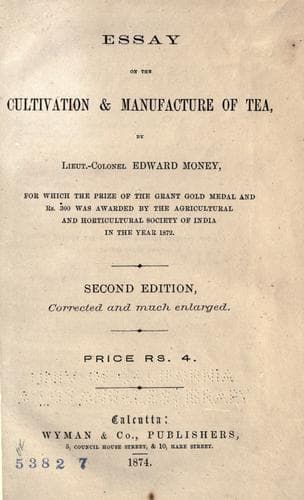
The Cultivation and Manufacture of TeaMoney, Edward
Science
The Cultivation and Manufacture of Tea
Money, Edward
Tea
Years ago, when I first mooted the idea that Tea could be fired
without charcoal, it was scouted. It was said, “The fumes of charcoal
had some chemical and necessary effect.” “The Chinese would not
have used it from time immemorial had a substitute, and a cheaper
one, been practicable.” Such were the objections. It is now no
longer a question. A great part, perhaps the greater part, of the
Indian produce is to-day worked with other fuel, and it is only
a question of time when _all_ of it will be so. It is generally
admitted that Tea prepared in Dryers is more valuable than that fired
over charcoal; and begging the question that the fumes of charcoal
are _not_ necessary (the old idea is very nearly exploded), it is
reasonable that it should be so; for, if there is one thing certain
in Tea manufacture, it is that speed is necessary. Charcoal drying
took on an average 45 minutes; Tea is fired in the best Dryers in
eight minutes. In respect of speed, Kinmond’s Dryer (which is the one
I advocate) is certainly unequalled.
When, as in large factories, 30 or 40 maunds of Tea have to be made
daily, it is evident that, _cæteris paribus_, the machine which will
do most in a given time and given space must be the best. In these
respects also Kinmond’s Dryer stands well, for the small size (No.
1) will do one maund, and the larger size (No. 2) will turn out two
maunds per hour. In other words, in a working day of 12 hours (and I
allow no more, for I do not believe in night work) 12 and 24 maunds
daily are the capacities of the two sizes. Considering that the said
two sizes, with necessary stokehole, tables, &c., occupy respectively
not more than 200 and 260 square feet of space in a factory, the
satisfactory results, in both the above respects, are unquestionable.
Tea made at night, both because the colour of it in its different
stages cannot be well seen (let the light be what it will), and also
because superintendence cannot then be so close, is never so good as
day-made Tea. This is _why_ I do not believe in night work; and it is
also a very important extra reason why machinery (which by its speed
enables all the necessary Tea to be made by daylight) will prove such
a great and lasting advantage.
When Kinmond’s Dryer was first constructed, it was proposed to work
it at 300 degrees. Later experience has proved 260 degrees is better
and sufficient; but of course more time is thus taken, and with the
old sizes one and two maunds per hour could not be turned out at the
lower temperature. The machines are now made one-fifth larger to
obviate this.
The fan is worked at 600 revolutions per minute, and this is found to
be the best speed.
Public-domain text, read in full here on John Shaqi.
Reviews
Reviews
No reviews yet
Be the first to share your thoughts on this work.
Elsewhere in the archive
Join the Discussion
Join the discussion
Sign in to leave a comment or review.
Sign InorCreate an account