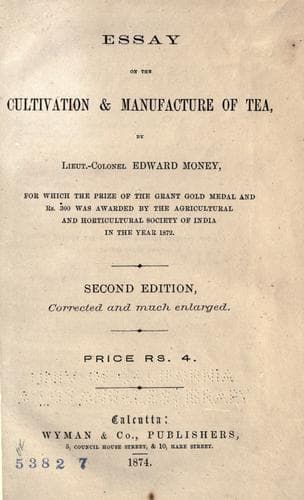
The Cultivation and Manufacture of TeaMoney, Edward
Science
The Cultivation and Manufacture of Tea
Money, Edward
Tea
2. With each entry the importer to give an endorsement of the net
contents of each package.
3. To test the accuracy of this endorsement, 10 per cent. of each
break to be turned out and weighed net.
4. If the difference between the weight given of any package and the
weight found exceeds or is less than 3 lbs., the whole parcel should
be weighed net.
5. Duty to be charged on the average weight of the packages weighed
net, unless the importer elects to weigh the whole parcel in the
usual way.
6. When the average of the packages weighed net amounts to so many
pounds and a-half, an additional pound will be charged on each of the
whole parcel; when the fraction is less than half a pound it is to be
rejected.
7. The new system to come into operation on July the 1st next.
FOOTNOTES:
[106] If tares are nearly equal, and if Teas are well bulked in India,
only some packages (about 10 per cent.) are opened, and an average tare
struck. But this in no way saves the loss in _quantity_ of Tea, though,
of course, less Tea is thus _injured_.
[107] Since I wrote the above the Customs have framed new rules for
Indian Teas. The absurd tare system is done away with.
ADDENDA
_TO THE THIRD EDITION_.
The following from the _Indian Economist_, regarding Indian Teas in
general and Neilgherry Teas in particular, is not out of place here. At
the same time I do not agree with the writer, for I believe that in the
strength and pungency of Indian Teas consists their value:--
INDIAN TEA.
Public-domain text, read in full here on John Shaqi.
Reviews
Reviews
No reviews yet
Be the first to share your thoughts on this work.
Elsewhere in the archive
Join the Discussion
Join the discussion
Sign in to leave a comment or review.
Sign InorCreate an account