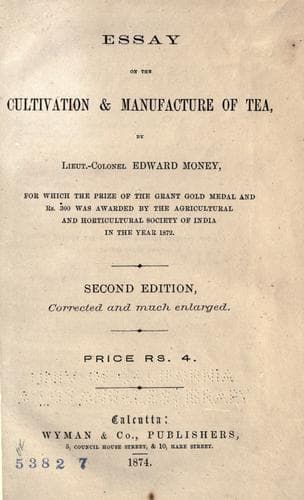
The Cultivation and Manufacture of TeaMoney, Edward
Science
The Cultivation and Manufacture of Tea
Money, Edward
Tea
“That the Teas of India have at length come to be fully appreciated
in England may be taken, we presume, as an admitted fact; and it
is of importance that planters should direct their attention to
modifying their methods of manufacture so as to suit the public
taste, and, if possible, turn out an article free from the objections
still advanced against the Indian leaf as a daily beverage. There
are, we know, those who argue that enough has been done, and that
consumers will acquire a taste for the produce of our gardens in
time; but we have daily evidence that in the most trivial matters
there is no greater tyrant than the public. It behoves those then who
cater for this tyrant to consult its taste and satisfy its demands,
however exacting and capricious they may be. The remarks we are about
to make are based on experiments and enquiries extending over some
years in this country and in England, and we leave those engaged in
the enterprise to estimate their value. All Teas grown in the plains
of India are known to the trade in London under the general name of
Assam, and are chiefly used for mixing, seldom reaching the consumer
in a pure state. When they do, the objections raised are that the
leaf is too pungent and rough for most palates; and purchasers are
in the habit of mixing it with Chinese to tone down those astringent
qualities. In other words, it wants the delicacy of flavour which
is the chief characteristic of the Chinese leaf, meaning of course
that vended by respectable houses, not the abominable trash that
formed part of the cargoes of the _Lalla Rookh_ and _Sarpedon_,
containing, according to Dr Letheby’s Analysis, ‘40 to 45 per
cent. of iron filings and 19 per cent. of silica.’ Nor is this lack
of delicacy of flavour to be lightly regarded, for the efforts of
our manufacturers have been directed unwittingly and indirectly
to foster the peculiarity, as the test of Indian Tea has hitherto
been its strength and pungency, to fit it for _salting_ weak, thin,
inferior sorts of Chinese. This is what the dealers have demanded,
and what, consequently, brokers in their turn have insisted on, with
the result that the out-turn of our Assam and Cachar plantations is
now, if anything, too powerful to suit public taste. Whether means
of manipulation may be hit upon by which aroma can be retained
without sacrificing strength, we leave those most interested to
determine; but it is worthy of note that this objection to strength
and roughness is almost confined to women, the sterner sex preferring
Assam unmixed, while the working classes of both sexes are unanimous
in favour of the unadulterated Indian article. Experiments were
further tried by substituting Neilgherry Tea, and after a short
interval the verdict of the majority was in its favour. We need
now only point out the difference in the manufacture between the
Public-domain text, read in full here on John Shaqi.
Reviews
Reviews
No reviews yet
Be the first to share your thoughts on this work.
Elsewhere in the archive
Join the Discussion
Join the discussion
Sign in to leave a comment or review.
Sign InorCreate an account