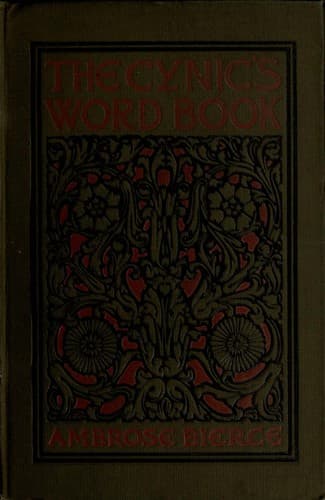
English language -- Dictionaries -- Humor; English language -- Semantics -- Humor; Vocabulary -- Humor
EXCEPTION, n. A thing which takes the liberty to differ from other
things of its class, as an honest man, a truthful woman, etc. "The
exception proves the rule" is an expression constantly upon the lips of
the ignorant, who parrot it from one another with never a thought of
its absurdity. In the Latin, "Exceptio probat regulam" means that the
exception tests the rule, puts it to the proof, not confirms meaning
from this excellent dictum and substituted a contrary one of his own,
exerted an evil power which appears to be immortal.
EXCESS, n. In morals, an indulgence that enforces by appropriate
penalties the law of moderation.
Hail high Excess!--especially in wine.
To thee in worship do I bend the knee
Who preach abstemiousness unto me--
My skull thy pulpit, as my paunch thy shrine.
Precept on precept, aye, and line on line,
Could ne'er persuade so sweetly to agree
With reason as thy touch, exact and free,
Upon my forehead and along my spine.
At thy command eschewing pleasure's cup,
With the hot grape I warm no more my wit;
When on thy stool of penitence I sit
I'm quite converted, for I can't get up.
Ungrateful he who afterward would falter
To make new sacrifices at thine altar!
EXCOMMUNICATION, n.
This "excommunication" is a word
In speech ecclesiastical oft heard,
And means the damning, with bell, book, and candle,
Some sinner whose opinions are a scandal--
A rite permitting Satan to enslave him
Forever, and forbidding Christ to save him.
Gat Huckle,
EXECUTIVE, n. An officer of the Government whose duty it is to enforce
the wishes of the legislative power until such time as the judicial
department shall be pleased to pronounce them mischievous and of no
effect. Following is an extract from an old book entitled, "The Lunarian
Astonished."
-- Pfeiffer & Co., Boston, 1803:
"Lunarian: Then when your Congress has passed a law it goes directly to
the Supreme Court in order that it may at once be known whether it is
constitutional.
"Terrestrian: O no; it does not require the approval of the Supreme
Court until having perhaps been enforced for many years somebody objects
to its operation against himself--I mean his client. The President, if he
approves it, begins to execute it at once.
"Lunarian: Then the executive power is a part of the legislative. Do
your policemen also have to approve the local ordinances that they
enforce?
"Terrestrian: Not yet--at least not in their capacity of constables.
Generally speaking though, all laws require the approval of those whom
they are intended to restrain.
"Lunarian: Ah, I see. The death warrant is not valid until signed by the
murderer.
"Terrestrian: My friend, you put it too strongly; we are not so
consistent.
Public-domain text, read in full here on John Shaqi.
Reviews
Reviews
No reviews yet
Be the first to share your thoughts on this work.
Join the Discussion
Join the discussion
Sign in to leave a comment or review.
Sign InorCreate an account