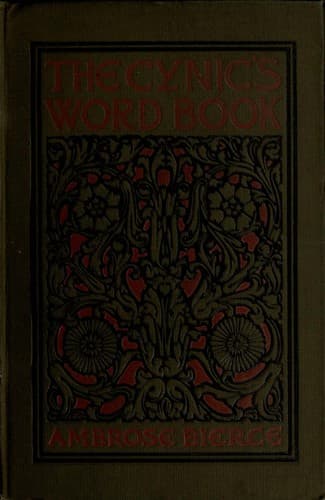
English language -- Dictionaries -- Humor; English language -- Semantics -- Humor; Vocabulary -- Humor
There is one insuperable obstacle to a belief in ghosts. A ghost never
comes naked: he appears either in a winding-sheet or "in his habit as
he lived." To believe in him, then, is to believe that not only have the
dead the power to make themselves visible after there is nothing left of
them, but that the same extraordinary gift inheres in textile fabrics.
Supposing the products of the loom to have this ability, what object
would they have in exercising it? And why does not the apparition of a
suit of clothes sometimes walk abroad without a ghost in it? These be
riddles of significance. They reach away down and get a convulsive grasp
on the very tap-root of this flourishing faith.
GHOUL, n. A demon addicted to the reprehensible habit of devouring
the dead. The existence of ghouls has been disputed by that class
of controversialists who are more concerned to deprive the world of
comforting beliefs than give it anything good in their place, but nobody
now seriously denies it. In 1640 Father Seechi saw one in a cemetery
near Florence and frightened it away with the sign of the cross. He
describes it as gifted with several heads and an uncommon allowance of
limbs, and he saw it in more than one place at a time. The good man was
coming away from dinner at the time and explains that if he had not
been "heavy with eating" he would have seized the demon at all hazards.
Atholston relates that a ghoul was caught by some sturdy peasants in a
churchyard at Sudbury and ducked in a horsepond. (He appears to think
that so distinguished a criminal should have been ducked in a tank of
rose-water.) The water turned at once to blood "and so contynues unto
ys daye." The pond has since been bled with a ditch. As late as the
beginning of the last century a ghoul was cornered in the crypt of
the cathedral at Amiens and the whole population surrounded the place.
Twenty armed men with a priest at their head, bearing a crucifix,
entered and captured the ghoul, which, thinking to escape by the
stratagem, had transformed itself to the semblance of a well-known
citizen, but was nevertheless hanged, drawn and quartered in the midst
of hideous popular orgies. The citizen whose shape the demon had assumed
was so affected by the sinister occurrence that he never again showed
himself in Amiens and his fate remains a mystery.
GLUTTON, n. A person who escapes the evils of moderation by committing
dyspepsia.
Public-domain text, read in full here on John Shaqi.
Reviews
Reviews
No reviews yet
Be the first to share your thoughts on this work.
Join the Discussion
Join the discussion
Sign in to leave a comment or review.
Sign InorCreate an account