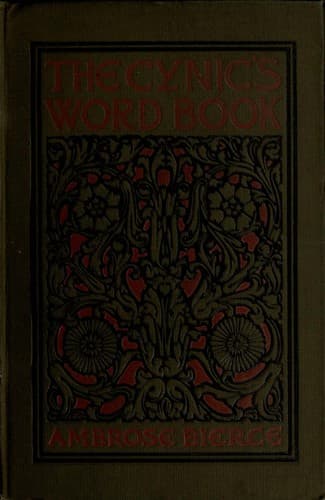
English language -- Dictionaries -- Humor; English language -- Semantics -- Humor; Vocabulary -- Humor
LEXICOGRAPHER, n. A pestilent fellow who, under the pretense of
recording some particular stage in the development of a language, does
what he can to arrest its growth, stiffen its flexibility, and mechanize
its methods. For your lexicographer, having written his dictionary,
comes to be considered "as one having authority," whereas his function
is only to make a record, not to give a law. The natural servility
of the human understanding having invested him with judicial power,
surrenders its right of reason and submits itself to a chronicle as if
it were a statute. Let the dictionary (for example) mark a good word as
"obsolete" or "obsolescent" and no man thereafter ventures to use
it, whatever his need of it and however desirable its restoration to
favor--whereby the process of impoverishment is accelerated and speech
decays. On the contrary, the bold and discerning writer who, recognizing
the truth that language must grow by innovation if it grow at all, makes
new words and uses the old in an unfamiliar sense has no following and
is tartly reminded that "it is n't in the dictionary"-- although down to
the time of the first lexicographer (Heaven forgive him!) no author ever
had used a word that was in the dictionary. In the golden prime and high
noon of English speech; when from the lips of the great Elizabethans
fell words that made their own meaning and carried it in their very
sound; when a Shakespeare and a Bacon were possible, and the language
now rapidly perishing at one end and slowly renewed at the other was in
vigorous growth and hardy preservation--sweeter than honey and stronger
than a lion--the lexicographer was a person unknown, the dictionary a
creation which his Creator had not created him to create.
God said: "Let Spirit perish into Form,"
And lexicographers arose, a swarm!
Thought fled and left her clothing, which they took
And catalogued each garment in a book.
Now, from her leafy covert when she cries:
"Give me my clothes and I 'll return," they rise
And scan the list, and say without compassion:
"Excuse us--they are mostly out of fashion."
Sigismund Smith.
LIAR, n. A lawyer with a roving commission.
LIBERTY, n. One of Imagination's most precious possessions.
The rising People, hot and out of breath,
Roared round the palace: "Liberty or death!"
"If death will do," the King said, "let me reign;
You 'll have, I 'm sure, no reason to complain."
Martha Braymance.
Public-domain text, read in full here on John Shaqi.
Reviews
Reviews
No reviews yet
Be the first to share your thoughts on this work.
Elsewhere in the archive
Join the Discussion
Join the discussion
Sign in to leave a comment or review.
Sign InorCreate an account