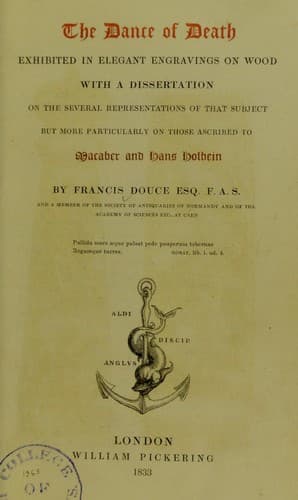
The Dance of Death: Exhibited in Elegant Engravings on Wood with a Dissertation on the Several Representations of that Subject but More Particularly on Those Ascribed to Macaber and Hans HolbeinDouce, Francis
History
The Dance of Death: Exhibited in Elegant Engravings on Wood with a Dissertation on the Several Representations of that Subject but More Particularly on Those Ascribed to Macaber and Hans Holbein
Douce, Francis
Bible. Old Testament -- Illustrations; Dance of death
21. Fine Lady. "Don't be so boisterous, you filthy wretch. I am a woman of
fashion."
22. Empress. "Fellow, I am an empress."
23. Young Lady. "Indeed, Sir, I am too young."
24. Old Bawd. "You may call me old bawd, if you please, but I am sure I
have always been a friend to your worship."
XVIII. Bonaparte's Dance of Death. Invented, drawn, and etched by Richard
Newton, 7 by 5.
1. Stabb'd at Malta. 2. Drown'd at Alexandria. 3. Strangled at Cairo. 4.
Shot by a Tripoline gentleman. 5. Devoured by wild beasts in the desert.
6. Alive in Paris.
CHAPTER XII.
_Books in which the subject is occasionally introduced._
To offer any thing in the shape of a perfect list of these, would be to
attempt an impossibility, and therefore such only as have come under the
author's immediate inspection are here presented to the curious reader.
The same remark will apply to the list of single prints that follows.
There is a very singular book, printed, as supposed, about 1460, at
Bamberg, by Albert Pfister. It is in German, and a sort of moral allegory
in the shape of complaints against Death, with his answers to these
accusations. It is very particularly described from the only known perfect
copy in the royal library at Paris, by M. Camus, in vol. ii. of "Memoires
de l'institut. national des sciences et arts: litterature et beaux arts,"
p. 6 et seq. It contains five engravings on wood, the first of which
represents Death seated on a throne. Before him stands a man with an
infant to complain that Death has taken the mother, who is seen wrapped in
a shroud upon a tomb. The second cut represents Death also on a throne
with the same person as before, making his complaint, accompanied by
several other persons at the feet of Death, sorrowfully deposing the
attributes of their respective conditions, and at the head of them a Pope
kneeling with one knee on the ground. The third cut has two figures of
Death, one of which, on foot, mows down several boys and girls; the other
is on horseback, and pursues some cavaliers, against whom he shoots his
arrows. The fourth cut is in two compartments, the upper representing, as
before, a man complaining to Death seated on a throne with a crown on his
head. Below, on the spectator's left hand, is a convent whence several
monks are issuing towards a garden encircled with hurdles, in which is a
tree laden with fruit by the side of a river; a woman is seen crowning a
child with a chaplet, near whom stands another female in conversation with
a young man. M. Camus, in the course of his description of this cut, has
fallen into a very ludicrous error. He mistakes the very plain and obvious
gate of the garden, for a board, on which, he says, _several characters
are engraved which may be meant to signify the arts and sciences, none of
which are competent to protection against the attacks of Death_. These
supposed characters, however, are nothing more than the flowered hinges,
Public-domain text, read in full here on John Shaqi.
Reviews
Reviews
No reviews yet
Be the first to share your thoughts on this work.
Elsewhere in the archive
Join the Discussion
Join the discussion
Sign in to leave a comment or review.
Sign InorCreate an account