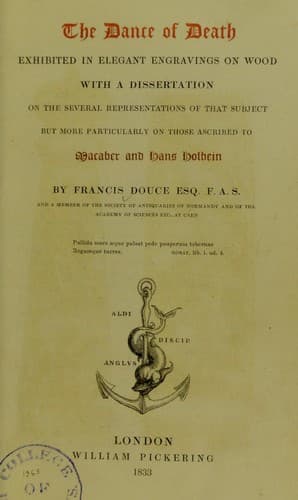
The Dance of Death: Exhibited in Elegant Engravings on Wood with a Dissertation on the Several Representations of that Subject but More Particularly on Those Ascribed to Macaber and Hans HolbeinDouce, Francis
History
The Dance of Death: Exhibited in Elegant Engravings on Wood with a Dissertation on the Several Representations of that Subject but More Particularly on Those Ascribed to Macaber and Hans Holbein
Douce, Francis
Bible. Old Testament -- Illustrations; Dance of death
ring or knocker, and lock of the door, which stands ajar. The fifth cut is
described as follows, and probably with greater accuracy than in M. Camus,
by Dr. Dibdin, from a single leaf of this very curious work in the
Bibliotheca Spenceriana, vol. i. p. 104, accompanied with a copy of part
of it only. "Above the figures there seen sits the Almighty upon a throne,
with an attendant angel on each side. He is putting the forefinger of his
left hand into the centre of his right, and upon each of the hands is an
eye, denoting, I presume, the omniscience of the Deity." The fac-simile
cut partly corresponds with M. Camus's description of Death, and the
complainant before Christ seated on a throne in a heaven interspersed with
stars. The above fourth cut among these is on a single leaf in the
possession of the author, which had Dr. Dibdin seen, he would not have
introduced M. Camus's erroneous account of it, who has also referred to
Heineken's Idée, &c. p. 276, where it certainly is not in the French
edition of 1771. 8vo.
In the celebrated Nuremberg Chronicle, printed in that city, 1493, large
folio, there is at fo. cclxiiii. a fine wood-cut of three Deaths dancing
hand in hand, another playing to them on a haut-boy. Below is a skeleton
rising from a grave. It is inscribed IMAGO MORTIS.
In the "Stultifera navis" of Sebastian Brant, originally printed in German
at Basle and Nuremberg, 1494, are several prints, finely cut on wood, in
which Death is introduced. In an edition printed at Basle, 1572, 12mo.
with elegant wood engravings, after the designs of Christopher Maurer, and
which differ very materially from those in the early editions, there is a
cut of great merit to the verses that have for their title, "Qui alios
judicat." It represents a man on his death bed; and as the poet's
intention is to condemn the folly of those who, judging falsely or
uncharitably of others, forget that they must die themselves, Death is
introduced as pulling a stool from under a fool, who sits by the bed-side
of the dying man. In the original cut the fool is tumbling into the jaws
of hell, which, as usual, is represented by a monstrous dragon.
In the "Calendrier des Bergers," Paris, 1500, folio, at sign. g. 6, is a
terrific figure of Death on the pale horse; and at sign. g. 5. Death in a
cemetery, with crosses and monuments; in his left hand the lid of a coffin
in which his left foot is placed. These cuts are not in the English
translation.
"Ortulus Rosarum," circa 1500, 12mo. A wood-cut of Death bearing a coffin
on his shoulder, leads a group consisting of a pope, a cardinal, &c.
Public-domain text, read in full here on John Shaqi.
Reviews
Reviews
No reviews yet
Be the first to share your thoughts on this work.
Elsewhere in the archive
Join the Discussion
Join the discussion
Sign in to leave a comment or review.
Sign InorCreate an account