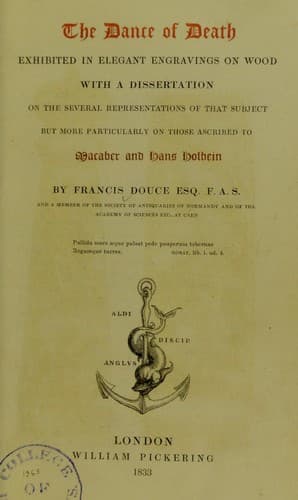
The Dance of Death: Exhibited in Elegant Engravings on Wood with a Dissertation on the Several Representations of that Subject but More Particularly on Those Ascribed to Macaber and Hans HolbeinDouce, Francis
History
The Dance of Death: Exhibited in Elegant Engravings on Wood with a Dissertation on the Several Representations of that Subject but More Particularly on Those Ascribed to Macaber and Hans Holbein
Douce, Francis
Bible. Old Testament -- Illustrations; Dance of death
In the dialogue "Of lyfe and death," at the end of "the dialoges of
creatures moralysed," probably printed abroad without date or printer's
name soon after 1500, are two engravings in wood, one representing Death
appearing to a man with a falcon on his fist, the other Death with his
spade leading an emperor, a king, and a duke. The latter is not found in
the Latin editions of this work, and has probably formed a part of some
very old Dance of Death.
In an edition of "Boetius de consolatione," Strasburg, 1501, folio, is a
figure of Death on a lean horse throwing his dart at a group of warriors.
In the "Freidanck," Strasburg, 1508, 4to, near the end is a wood-cut of a
garden, in which two men and two women are feasting at a table. They are
interrupted by the unexpected appearance of Death, who forcibly seizes one
of the party, whilst the rest make their escape.
In the "Mortilogus" of Conrad Reitter, Prior of Nordlingen, printed at
Augsbourg by Erhard Oglin and Geo. Nadler, 1508, 4to. there is a wood-cut
of Death in a church-yard, holding a spade with one hand and with the
other showing his hour-glass to a young soldier; and another of Death
shooting an arrow at a flying man.
In "Heures à l'usaige de Sens," printed at Paris by Jean de Brie, 1512,
8vo. the month of December in the calendar is figured by Death pulling an
old man towards a grave; a subject which is, perhaps, nowhere else to be
found as a representation of that month. It is certainly appropriate, as
being at once the symbol of the termination of the year and of man's life.
In the "Chevalier de la Tour," printed by Guillaume Eustace, Paris, 1514,
folio, there is an allegorical cut, very finely engraved on wood, at fo.
xxii. nearly filling the page. The subject is the expulsion of Adam and
Eve from Paradise, the gate of which exhibits a regular entrance, with
round towers and portcullis. Behind this gate is seen the forbidden tree,
at the bottom of which is the Devil, seemingly rejoicing at the expulsion,
with an apple in his hand. Near the gate stands the angel with his sword,
and a cross on his head. Between him and the parties expelled is a
picturesque figure of Death with a scythe ready for action.
"Horæ ad usum Romanum," printed for Geoffrey Tory of Tours, 1525. Before
the Vigiliæ Mortuorum is a wood-cut of a winged Death holding a clock in
one hand; with the other he strikes to the ground and tramples on several
men and women. Near him is a tree with a crow uttering CRAS CRAS. In
another edition, dated 1527, is a different cut of a crowned figure of
Death mounted on a black mule and holding a scythe and hour-glass. He is
trampling on several dead bodies, and is preceded by another Death, armed
also with a scythe, whilst a third behind strikes the mule, who stops to
devour one of the prostrate figures. Above is a crow.
Public-domain text, read in full here on John Shaqi.
Reviews
Reviews
No reviews yet
Be the first to share your thoughts on this work.
Elsewhere in the archive
Join the Discussion
Join the discussion
Sign in to leave a comment or review.
Sign InorCreate an account